
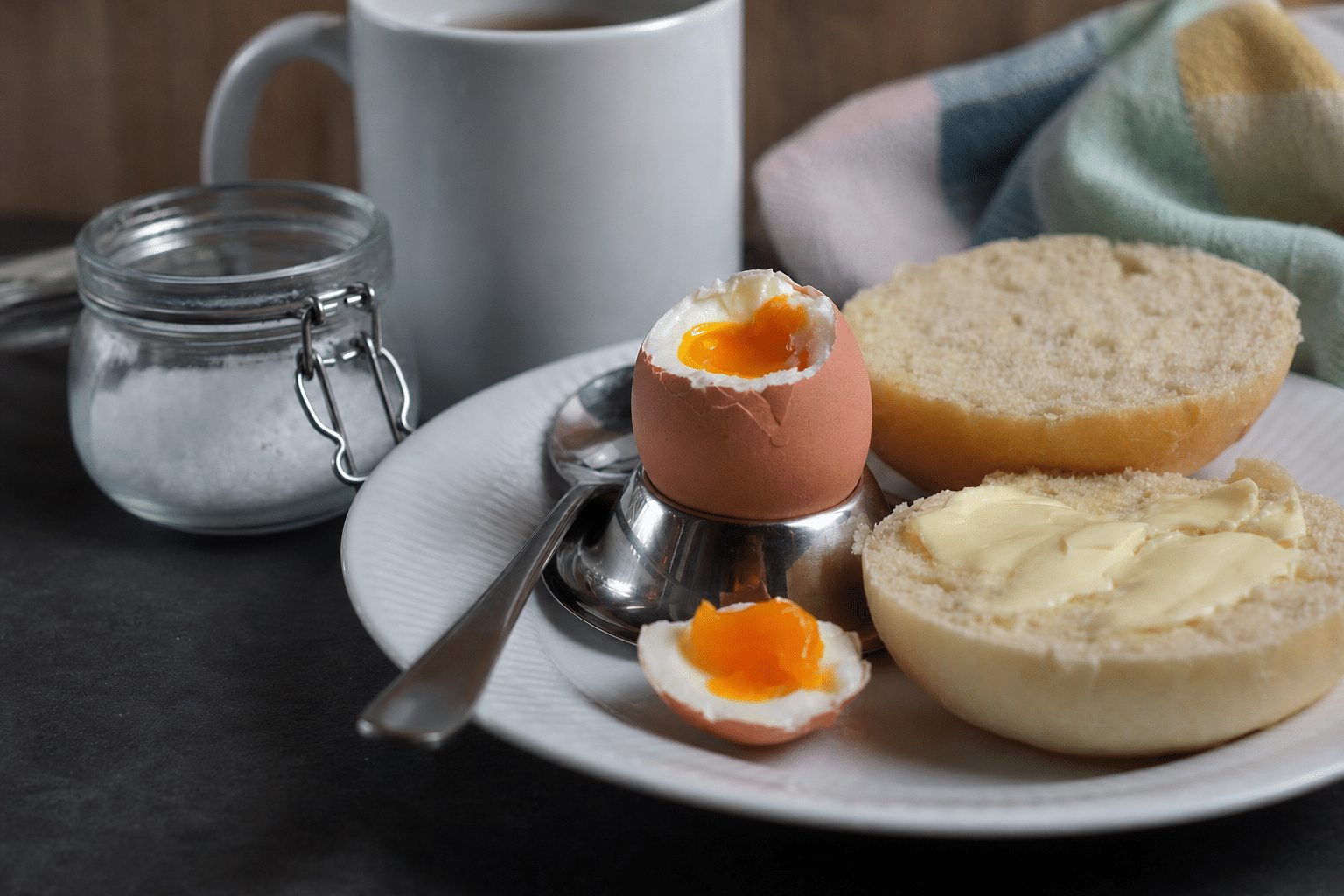

I teach food science, and I have made a lot of boiled eggs. I have also ruined a lot of them, mostly before I understood that the method has very little margin for error. The good news: once you know the two things that actually matter, you get it right every time.
Those two things are when you start timing, and when you stop cooking.
The one rule you cannot skip
Bring your water to a full rolling boil before the eggs go in. Lower them in gently with a spoon, start your timer the moment they hit the water, and reduce the heat to a steady simmer.
This is the most common mistake I see: people start in cold water. The problem is that cold-water heating varies depending on your burner, your pot, and how full it is.
You cannot control it, which is exactly why timing guides based on cold starts give you ranges instead of exact minutes. There are too many variables.
Boiling water is boiling water. The egg hits 212°F (100°C) immediately. That is the repeatable starting point, and it is what makes precise timing possible.
Read more: Bibimbap from scratch: the Korean rice bowl with seasoned meat, vegetables, and a fried egg
Egg size matters more than you think
A medium egg and a large or extra large egg are not interchangeable in timing. A larger egg needs about 30 extra seconds to reach the same doneness inside. That half-minute is the difference between a runny yolk and a set one.
The timings below split accordingly between medium eggs and large or extra large eggs. Most US home cooks buy large by default, so the right column will be your anchor.
Exact timings by size and doneness
These times apply to eggs straight from the refrigerator, dropped into already-boiling water.
Result | Medium egg | Large/extra large egg | Ice bath |
|---|---|---|---|
Soft-boiled (serve warm) | 6 min | 6 min 30 sec | 30-60 sec |
Jammy (serve warm) | 6 min 30 sec | 7 min | 1 min |
Jammy (serve cold) | 7 min | 7 min 30 sec | 3-4 min |
Hard-boiled | 9 min | 10 min | 4-5 min |
The “jammy” row appears twice because how you serve the egg changes the target. When you are eating it straight from the pot, a shorter cook gets you that creamy, fudgy orange yolk.
If you are prepping ahead and eating the eggs fridge-cold, you need a little more time in the water: cold temperature firms up the yolk texture, so the extra half-minute is what delivers the same creamy result once chilled.
Jammy is, in my opinion, the best state an egg can be in. The white is fully set, the yolk is deep orange and holds together when sliced but gives when you press it.
Read more: Asian beef salad with seared ribeye, crispy cabbage, and a sesame-lime dressing, ready in 30 minutes
It is what good ramen shops use, and it works just as well on toast, in a grain bowl, or sliced over a salad.
The ice bath is not optional
Most home cooks skip the ice bath. It feels fussy for something as simple as a boiled egg. I understand that instinct, but the ice bath is not a finishing touch: it is a part of the cooking method itself.
Eggs keep cooking from residual heat after they leave the water. Without stopping that heat, a 7-minute egg becomes an 8-minute egg on the way to the table. For soft and jammy results, that ruins it.
Fill a bowl with cold water and a generous handful of ice cubes before you even turn on the stove. When the timer goes off, transfer the eggs with a slotted spoon right away.
For soft-boiled eggs, 30 to 60 seconds in the ice bath is enough to halt the cooking while keeping the egg warm to serve. For hard-boiled, let them sit 4 to 5 minutes.
Read more: How to make hummus as smooth as a restaurant’s, with one cold-water blending trick
Peeling without the frustration
Start from the broader end of the egg. There is a small air pocket there, and cracking through it first lets the shell separate more cleanly. Tap the egg gently on the counter, roll it lightly to craze the whole shell, then peel under a thin trickle of cold water.
One thing that surprises most people: very fresh eggs are significantly harder to peel than eggs that have been in the refrigerator for a week or two.
Fresh whites bond tightly to the shell membrane. If you are making deviled eggs or a dish where clean peeling matters, use eggs that are at least a week old.
A small pin-hole pricked in the broader end before cooking can also help: it releases trapped air, reduces the chance of cracking during cooking, and makes the shell come off more cleanly.
That said, if you cool the eggs properly and start peeling from the right end, the shell comes off in about ten seconds.