
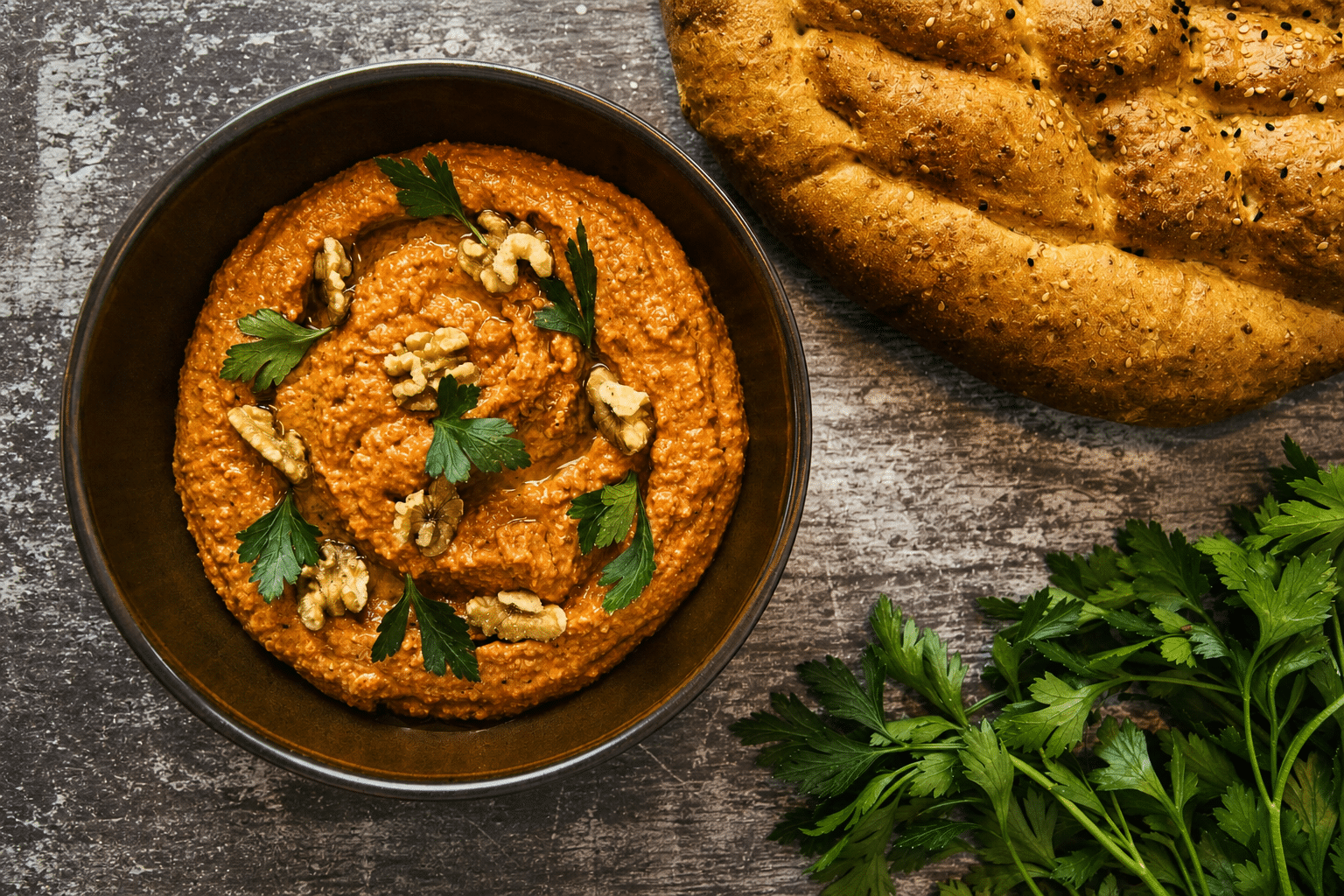

If you’ve never had muhammara, this is your moment. It comes from Aleppo in northern Syria, and the name literally means “red” – which makes sense, because this dip is built entirely on fire-roasted red peppers, burnished with smoked paprika, and deepened with a hit of pomegranate molasses. Walnuts give it body. Tomato paste pulls it all together.
The texture is thick, rustic, and spreadable – nothing like the smooth paste of hummus. The flavors hit in layers: smoky first, then nutty, then that bright, almost sour tang from the pomegranate and lemon. Every time it comes out at a party, it disappears before anything else does.
Why this recipe works
Most muhammara recipes throw everything in the blender at once and hope for the best. This version starts differently: the walnuts go in first, by themselves, blitzed down to fine crumbs before anything else gets added. Skip that step and you end up with uneven chunks in an otherwise smooth puree. Do it right and the walnuts become the structural backbone that holds the whole dip together.
Breadcrumbs come in next, acting as a thickener that keeps the dip spreadable rather than soupy. Then the olive oil goes in last, drizzled in slowly while the blender runs. That slow pour is the move that separates a cohesive, restaurant-quality dip from one that looks broken and oily.
Ingredients
Serves 4
Ingredient | US measure | Metric |
|---|---|---|
Walnuts | 1 cup | 100 g |
Roasted and peeled red bell peppers | 10 oz (one 12 oz jar, drained) | 300 g |
Plain breadcrumbs | ½ cup | 50 g |
Pomegranate molasses | 1½ tablespoons | 30 g |
Tomato paste | 1½ tablespoons | 20 g |
Fresh lemon juice | 2 teaspoons | 10 g |
Garlic | 1 clove, finely minced | 5 g |
Smoked paprika | 1 teaspoon | 3 g |
Extra virgin olive oil | 7 tablespoons | 100 g |
Fine salt | 1 teaspoon | 5 g |
Sugar | 1 teaspoon | 5 g |
Instructions
1. Put the walnuts into a food processor or blender and blitz them on their own until they reach a fine, crumbly texture – closer to coarse flour than chunky pieces. This step sets up the whole dip, so take the time to do it properly.
Read more: Kolokithokeftedes: crispy Greek zucchini fritters with feta, mint, and dill, served with tzatziki
2. Add the roasted red peppers, breadcrumbs, pomegranate molasses, and tomato paste. Blend for about 2 minutes until everything is thoroughly combined and the mixture looks uniform.
3. Add the lemon juice, minced garlic, and smoked paprika. Blend for another full minute.
4. With the blender running, slowly drizzle in the olive oil in a thin, steady stream. Keep the pace slow and even – pouring too fast can cause the dip to break and turn greasy. Take your time and the texture will stay smooth and cohesive.
Read more: The homemade cranberry sauce that tastes so much fresher, and takes just 15 minutes
5. Add the salt and sugar, then taste and adjust. You’re looking for a balance of smoky, nutty, sweet, and tangy – no single note should dominate. Keep tasting and nudging until it’s right.
Tips and variations
Where to find pomegranate molasses: Look for it in the international or Middle Eastern aisle of larger grocery stores, at any Middle Eastern or Mediterranean market, or online. It is thick, dark, and intensely tangy. Nothing substitutes well for it, so it is worth seeking out.
Jarred vs. fresh peppers: Jarred roasted red peppers work perfectly here and save significant time. If you prefer to roast your own, char whole peppers directly over a gas flame or under the broiler, turning until blackened all over, then seal them in a zip-top bag for 10 minutes and peel. Dry them thoroughly with paper towels before blending or the dip will turn watery.
Read more: The whiskey cream sauce for steak that builds flavor in layers and beats anything from a jar
Texture: Muhammara is supposed to be rough and a little rustic, not silky smooth like hummus. If it looks slightly uneven, that is correct. Do not over-blend chasing a perfect uniform consistency – you will lose the character.
Make-ahead and storage: Muhammara keeps well in a sealed container in the refrigerator for 3 to 5 days. The flavor deepens overnight, so making it a day ahead is not a bad idea. Bring it fully to room temperature before serving – cold muhammara mutes all the complexity.
Serving: Drizzle extra virgin olive oil generously over the top and scatter a few walnut halves or fresh pomegranate seeds to finish. Serve with warm flatbread, pita, or crunchy vegetable sticks. It also works as a spread in sandwiches or as a sauce spooned alongside grilled chicken or lamb.
Allergens: This recipe contains tree nuts (walnuts) and gluten (breadcrumbs). For a gluten-free version, swap in certified gluten-free breadcrumbs.