

Changing dinner plans or buying more than you need at the store are everyday realities, and so is the question of whether thawed meat can go back in the freezer. The answer is not a flat yes or no. USDA FSIS has specific rules for each thawing method, and they differ in one critical way.
Here is what the official guidance says for each of the three safe defrosting methods.
Thawed in the refrigerator: safe to refreeze
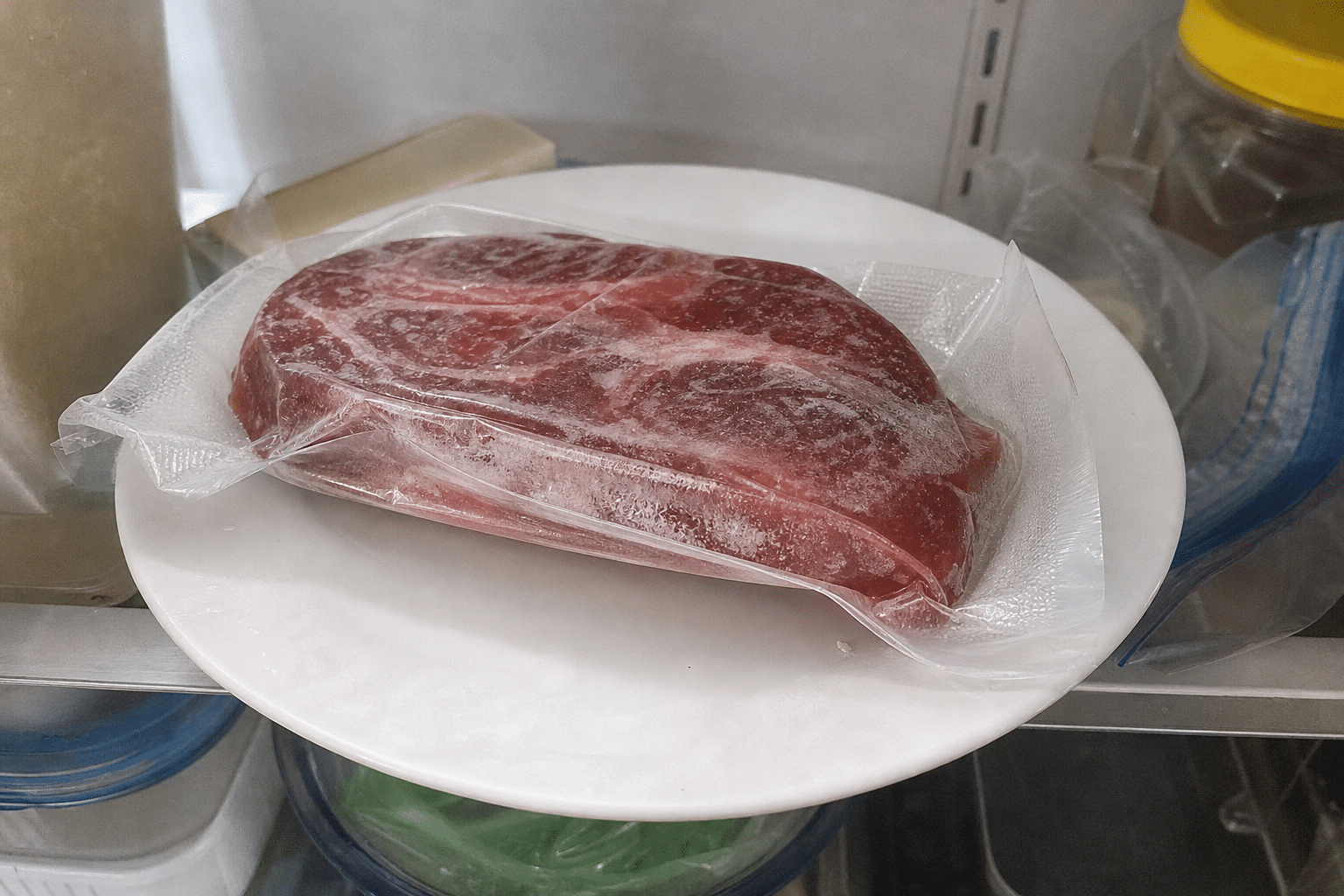
Meat thawed in the refrigerator can go straight back into the freezer without cooking. USDA FSIS is clear: “Once food is thawed in the refrigerator, it is safe to refreeze it without cooking, although there may be a loss of quality due to the moisture lost through thawing.”
The reason refrigerator thawing earns this flexibility is temperature. The fridge holds food at a constant 40°F (4°C) or below throughout the entire thaw, so the meat never passes through the temperature range where bacteria multiply rapidly.
A small package of ground meat or boneless chicken breasts needs about 24 hours in the fridge to thaw fully, so plan ahead.
Read more: Spaghetti and meatballs from scratch: the long-simmered tomato sauce that makes all the difference
Expect slightly softer texture after a second freeze. Quality drops a little, but safety does not.
Thawed in cold water: cook before refreezing
Cold water thawing is faster than the fridge, but the refreezing rule is stricter. According to USDA FSIS, food thawed by the cold water method must be cooked before refreezing.
The process requires meat to be in a leak-proof bag, submerged in cold water that is changed every 30 minutes. A 3- to 4-pound package takes roughly 2 to 3 hours to thaw this way.
Because the outer layer of the meat passes through the danger zone during the process, it must go straight from the water to the stove or oven. After cooking, the cooked meat can be refrozen.
Thawed in the microwave: cook before refreezing
Microwave-thawed meat follows the same rule: cook it before refreezing. USDA FSIS explains that “some areas of the food may become warm and begin to cook during microwaving,” meaning parts of the meat have already entered unsafe temperature territory before you even open the bag.
Plan to cook microwave-thawed meat immediately. After cooking, the cooked meat can be refrozen safely.
Read more: Penne alla vodka at home: the pasta with 100 million views that is easier than you think
The 2-hour danger zone rule
All three refreezing rules trace back to one principle: the danger zone. USDA FSIS defines it as the temperature range between 40°F (4°C) and 140°F (60°C), where bacteria can double in number in as little as 20 minutes.
Cold water and microwave thawing both push the outer layers of meat through that range during defrosting, which is why both require cooking before anything goes back in the freezer. Refrigerator thawing stays at or below 40°F throughout, so the danger zone is never crossed.
The hard cutoff applies whether you are actively thawing or simply forgot to put something away: never leave perishable food out of refrigeration for more than 2 hours. If the ambient temperature is above 90°F (32°C), that window drops to 1 hour.
“`