
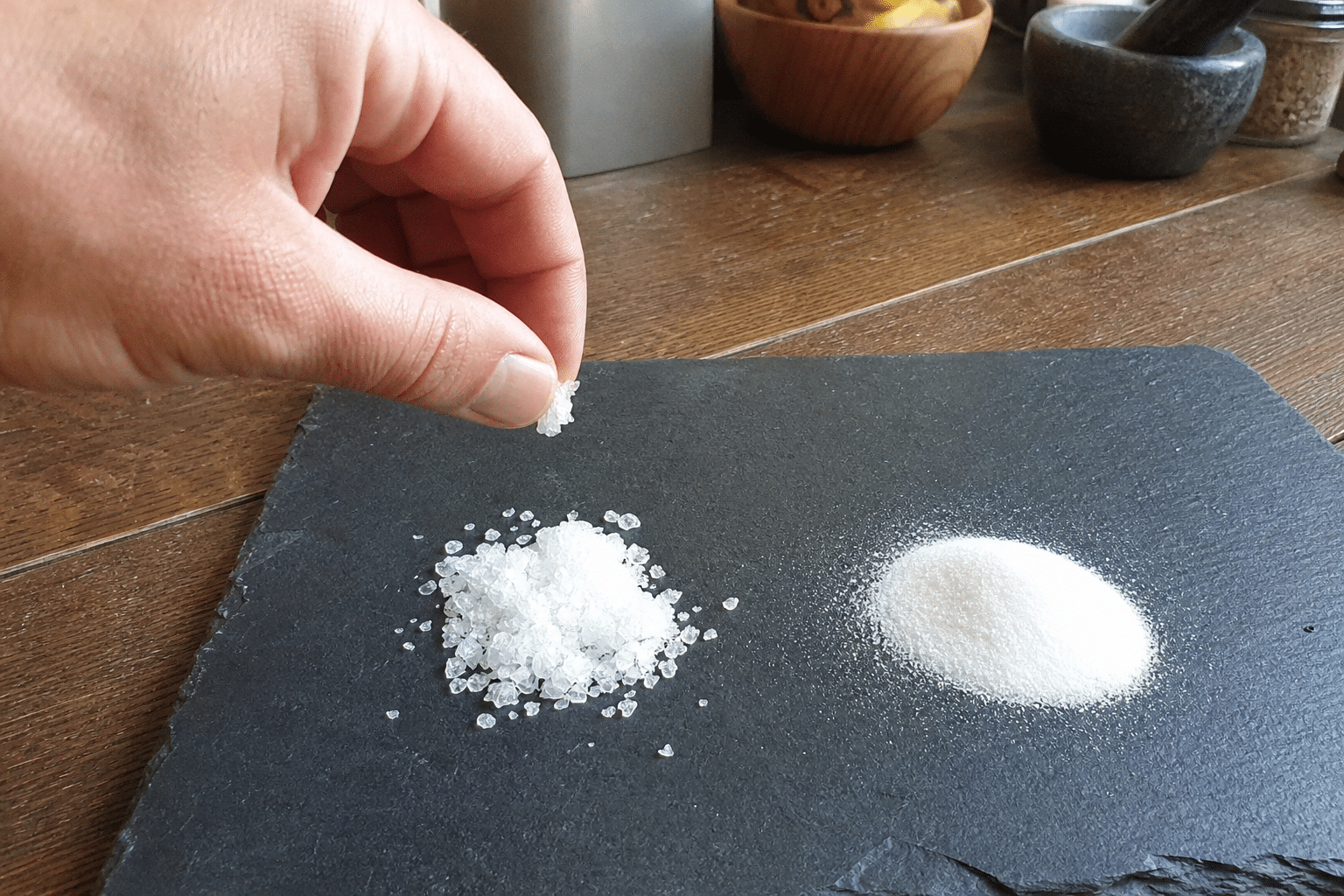

The specialty salt aisle has expanded considerably over the past two decades. Flaky finishing salts, gray fleur de sel, coarse sea salt, and pink Himalayan varieties now fill shelves alongside basic iodized table salt, often packaged with health-forward language suggesting a smarter nutritional choice. University of Illinois Extension registered dietitian nutritionist Jenna Smith examined that claim in a June 2024 article and found the case for the upgrade essentially doesn’t hold up.
The sodium is the same
Both sea salt and table salt contain about 40% sodium by weight, according to Smith’s piece on the University of Illinois Extension blog. Yet a survey she cited found that 61% of respondents thought sea salt was a lower-sodium alternative to table salt. It is not.
The only scenario where sea salt yields slightly less sodium is by volume. Its larger crystals do not pack as tightly into a teaspoon, so you get a little less salt per spoonful. At the small amounts used in finishing or home cooking, that volume gap is too small to matter.
Worth keeping in perspective: Smith notes that 90% of Americans already consume more salt than the recommendation. Switching salt brands changes nothing about that figure.
Trace minerals: present but clinically insignificant
Sea salt is produced by evaporating seawater with minimal processing. That lighter handling leaves behind small amounts of minerals, such as magnesium, calcium, potassium, and iron, though they are only present in trace amounts, as University of Illinois Extension puts it.
Read more: The science behind why bread stales faster in the fridge than on the counter
At the quantities of salt a person would actually consume, those trace amounts add nothing meaningful to daily nutrition. Each of those minerals appears in far greater concentrations in ordinary foods like dairy, vegetables, beans, and fish, making salt an unnecessary vehicle for them.
The iodine gap: the one difference that counts
This is where the two salts diverge in a genuinely health-relevant way. Table salt sold in the United States is routinely fortified with iodine. Most sea salts are not.
The thyroid gland requires iodine to produce its hormones. Through its contribution to thyroid hormone production, iodine supports a growing baby’s bones, tissues, and brain cells, according to the American Thyroid Association.
Read more: These slow-cooked beef short ribs practically make themselves, and they’re perfect for the holidays
Unlike nearly two-thirds of the countries in the world, the U.S. does not mandate fortification of salt with iodine, the ATA reports. A 2015 analysis of retail scanner data published in Nutrients found that only 53% of salt sold in the US (excluding blends) was iodized, meaning close to half the salt on US shelves carries no iodine at all.
For people who eat dairy and seafood regularly, both naturally good sources of iodine, switching to sea salt poses no meaningful risk. The concern is for anyone whose diet is low in those foods and who has moved entirely to non-iodized sea salt.
The ATA and the American Academy of Pediatrics jointly recommend that pregnant and breastfeeding women in the US supplement with 150 mcg of iodine daily, noting that mild iodine deficiency may be widespread in US pregnancies despite adequate intake at the population level.
Read more: Croque Madame: the French toasted ham and cheese that makes brunch worth staying home for
Where sea salt earns its place
The case for sea salt is culinary, not nutritional. Finishing salts, particularly coarse or flaky varieties, have irregular crystals that dissolve more slowly on the palate and deliver a bright, distinct burst of salinity when sprinkled over food just before serving. On a piece of grilled meat, a chocolate chip cookie, or a ripe summer tomato, that textural contrast is noticeable and worth having.
For cooking where salt dissolves into the food (seasoning pasta water, brining, baking), the distinction disappears entirely. Table salt and kosher salt (also coarser than table salt, also typically non-iodized) both season evenly and predictably.
The practical choice
For most cooks eating a varied diet that includes dairy and seafood, using sea salt involves no health trade-off. For those whose diets are low in those iodine-rich foods, iodized table salt should remain the everyday staple.
Not all table salt is iodized, and a small number of sea salt brands do add iodine. The word “iodized” on the packaging is the only reliable indicator.