
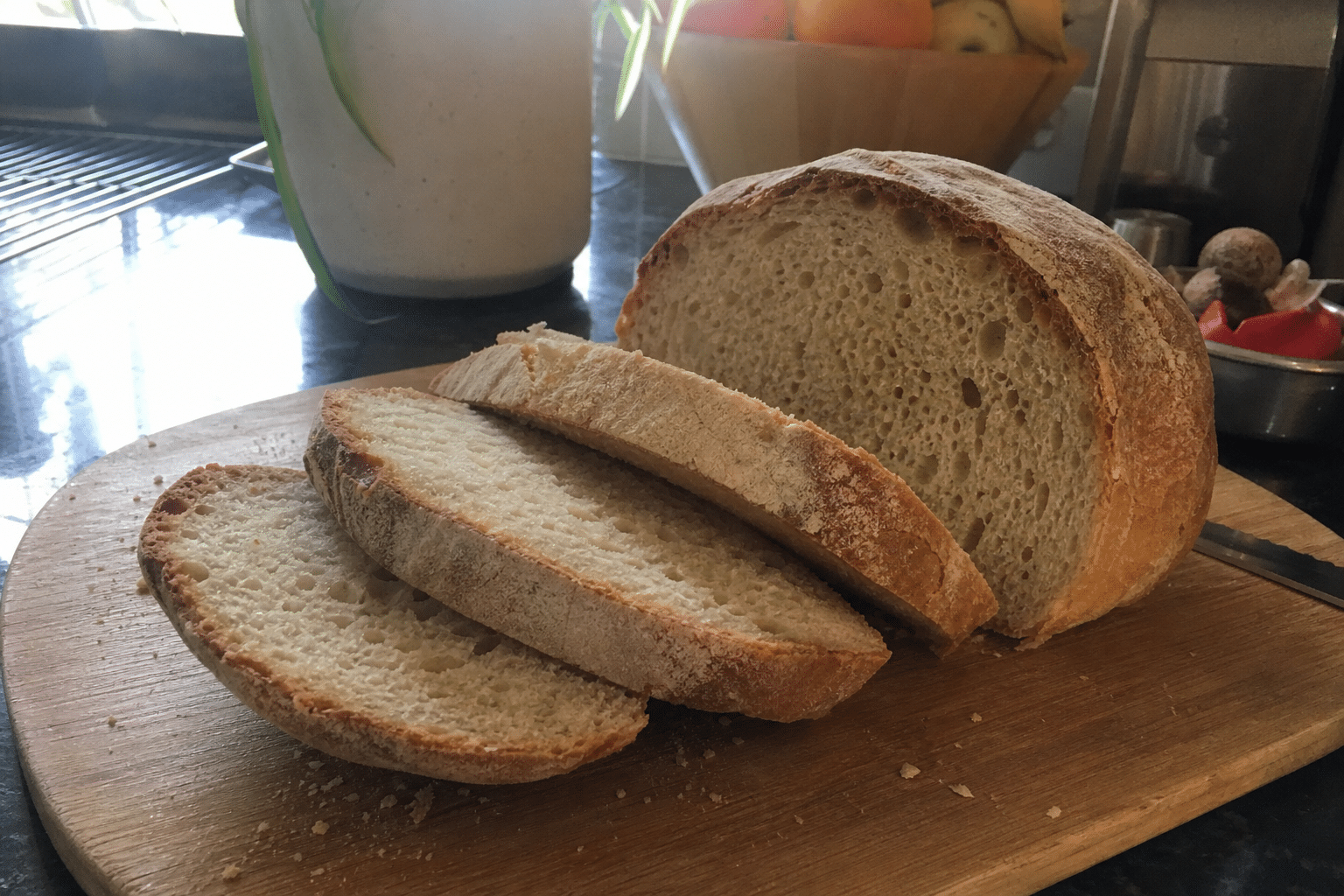

Reaching for the fridge to preserve leftover bread is an easy impulse. Cold slows things down – that’s the logic. But bread doesn’t spoil the way milk or meat does. It stales through a chemical process driven by temperature, and the refrigerator happens to run right at a temperature where that process moves fast.
Why bread goes stale (and it is not just drying out)
A tightly wrapped loaf can grow completely firm while barely losing any moisture to the air. The hardness comes from a molecular shift inside the crumb, not from evaporation.
When bread is baked, starch granules in the flour absorb water and swell – a process called gelatinization. This is what gives a fresh loaf its soft, springy crumb. As the loaf cools, those starch molecules begin rearranging. Instead of staying loosely ordered and water-bound, they link back together into tighter crystalline structures. This is retrogradation, and it is what makes bread firm and crumbly.
According to a wheat starch retrogradation study published in PubMed Central, retrogradation involves “the destruction of the original granular crystalline structure (gelatinization), and then reconstruction of the novel crystalline structure.” The result: harder texture, reduced water-holding capacity, and increased fragmentation.
Amylose and amylopectin: two speeds, one stale loaf
Wheat starch contains two types of molecules: amylose (long, linear chains) and amylopectin (large, branched molecules). They retrograde on different timescales.
Read more: These slow-cooked beef short ribs practically make themselves, and they’re perfect for the holidays
Amylose crystallizes quickly. The same PubMed Central study states that “amylose rearrangement proceeds quickly and begins immediately upon storage.” This is why bread starts to feel slightly different within hours of coming out of the oven.
Amylopectin recrystallizes slowly, over weeks or even months, but it is the main driver of the firming you notice over days. As retrogradation progresses, water that was held loosely in the gelatinized starch gets locked inside the growing crystals, where it is no longer available to keep the crumb soft. The bread becomes hard and crumbly even when it was perfectly sealed.
The fridge runs at the worst possible temperature for bread
Starch retrogradation involves two processes, nucleation (crystal formation) and propagation (crystal growth), both of which require temperatures above the glass transition point (−5°C) and below the melting point (60°C). A peer-reviewed study published in PubMed Central confirms that refrigerator temperatures fall within this window and accelerate the overall staling rate above what occurs at room temperature.
That same study tracked the firming rate of pan wheat bread and sourdough stored in sealed plastic bags at refrigerator temperature (8.2°C/46.8°F) versus room temperature (21.9°C/71.4°F). Pan wheat bread firmed at a rate of 0.41 N/d in the fridge versus 0.29 N/d at room temperature – roughly 40% faster. Sourdough showed a similar gap: 1.38 N/d in the fridge versus 0.92 N/d at room temperature.
Read more: Croque Madame: the French toasted ham and cheese that makes brunch worth staying home for
The study concludes that low temperatures “accelerate the firming rate in starch gels” and that “the starch retrogradation rate… is higher for refrigerator temperatures.”
The freezer behaves differently. Below roughly -5°C (23°F), starch molecules lose the mobility needed for efficient crystallization. Freezing arrests retrogradation; refrigerating accelerates it.
How heat reverses staling – at least temporarily
Retrogradation is not a one-way process. Heat above approximately 60°C (140°F) melts the amylopectin crystals that have already formed, restoring softness to the crumb. This is why toasting or briefly oven-warming stale bread works.
Read more: The apple pie trick that stops a soggy bottom crust before it ever happens
According to Domson’s bread technology guide, “heating bread above approximately 60°C dissolves amylopectin crystals, which is why briefly reheating stale bread in an oven or microwave restores softness. However, re-staling is faster on the second cycle.” Once a loaf has been reheated and re-cooled, the subsequent retrogradation proceeds more quickly than the first time around, so a warmed slice is better eaten soon.
For a whole loaf, lightly wetting the outside crust and placing it in a 300°F (150°C) oven for 10-20 minutes restores more crumb softness than a microwave, which heats unevenly and can make the crust leathery.
The one exception: filled bread needs the fridge
This all applies to plain bread – a simple loaf, a baguette, a dinner roll. If the bread contains perishable fillings such as deli meat, cooked egg, cheese, or cream-based spreads, food safety takes priority over texture. Those ingredients require refrigeration to prevent bacterial growth. Store filled sandwiches cold and eat them within a day or two.
What actually works for storing plain bread
- Room temperature, up to 2-3 days: Keep in a closed bag, bread box, or airtight container. The crumb holds up significantly better than in the fridge, though the crust will soften over time.
- Freezer for longer storage: Slice the loaf before freezing so you can pull individual pieces as needed. Bread goes straight from the freezer to the toaster without thawing.
- Fridge: Skip it for any plain bread. Crumb staling runs about 40% faster at refrigerator temperatures than at room temperature, based on peer-reviewed data – more than enough to notice by day two or three.