
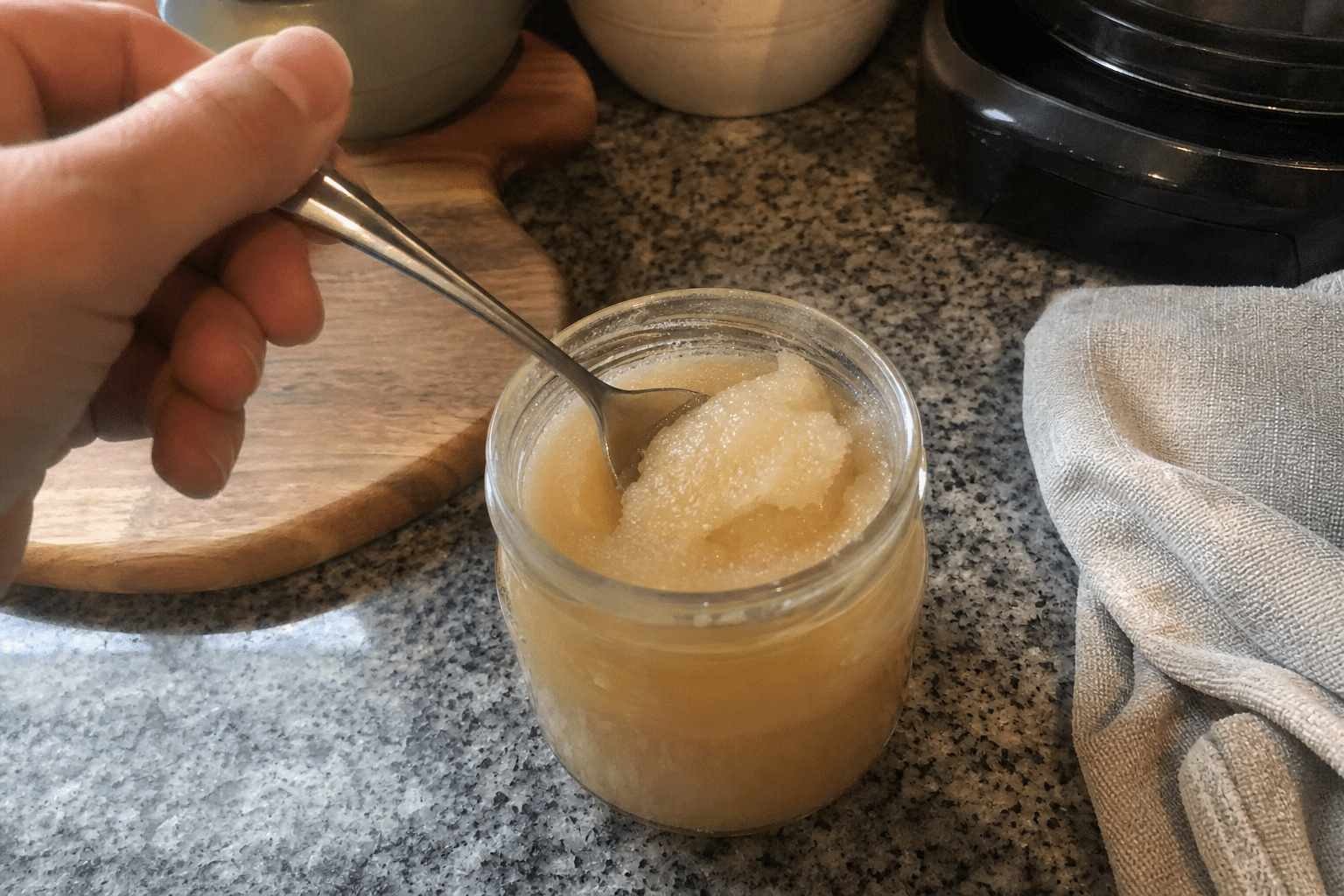

Honey crystallizes. Every variety eventually will. It is not a sign of age or spoilage. The National Honey Board confirms that crystallized honey is completely safe to eat and identical in quality to liquid honey. Undoing it takes nothing more than warm water and a little patience.
Why honey turns solid
Honey is a supersaturated solution, meaning it holds more sugar than water can normally keep dissolved. It contains two main sugars: glucose and fructose. Fructose stays in solution readily. Glucose has lower solubility, and over time it separates from the liquid and forms crystals.
As Healthline notes, even when honey is stored correctly, crystallization is entirely normal and not a sign of spoilage. The white solid you see is simply glucose monohydrate settling into its natural stable state.
Which honeys crystallize fastest
The ratio of glucose to fructose in a given variety is the main factor that determines how quickly it will crystallize. More glucose means faster crystallization; more fructose keeps it pourable longer.
Read more: Slow-braised pork shoulder with fresh apple cider: a fork-tender fall roast
Clover and canola honey, the most common types in US grocery stores, typically solidify within two to six months. Canola has a glucose-to-fructose ratio of roughly 1.00 (nearly equal parts of each sugar) and typically crystallizes within two to four months. Acacia and tupelo honey are both high in fructose, with acacia having a glucose-to-fructose ratio as low as 0.61, meaning they can stay liquid for two years or more.
Heavily filtered commercial honey also stays liquid longer. The National Honey Board explains that “filtering helps delay crystallization, helping the honey to remain liquid for a much longer period than unfiltered honey.”
Cold makes it happen faster
The crystallization process moves fastest at around 50 to 59°F (10 to 15°C), which is close to refrigerator temperature or a cold pantry shelf. Storing honey in the refrigerator will speed up crystallization and make it noticeably thicker and denser.
Read more: Beef stroganoff from scratch: silky sauce, done in 30 minutes
The National Honey Board notes that cooler temperatures, specifically between 35 and 60°F, actively drive the process. Keep honey in a closed cabinet at room temperature, away from cold drafts. Above around 77°F (25°C), glucose stays dissolved and crystallization slows significantly.
How to bring it back to liquid
Crystallized honey is fully reversible. The correct method is a gentle warm water bath.
Place the closed jar in a bowl or small pot of water heated to between 95 and 110°F (35 to 43°C). That is warm to the touch but not uncomfortable to hold your hand in. Stir the honey occasionally as the crystals dissolve. A standard jar takes about an hour to return to fully liquid.
Read more: Hot Duck: the duck confit hotdog with sriracha mayo that is the best use of holiday leftovers
Do not use a microwave. The heat is uneven and the temperature is impossible to control. Keep the bath below 110°F (43°C): Healthline warns not to “overheat or boil it as that will degrade its color and flavor,” and enzymes in raw honey break down at temperatures above that threshold.
What you will see
The appearance of crystallized honey can look alarming if you have not encountered it before. The color shifts from deep amber to a lighter, almost creamy white. The texture turns grainy and the honey goes opaque rather than clear. These are normal changes that reverse completely once the honey warms back up.
Crystallized honey in a sealed container at room temperature is safe to eat as-is, spread directly on toast or stirred into oatmeal without any warming needed.