
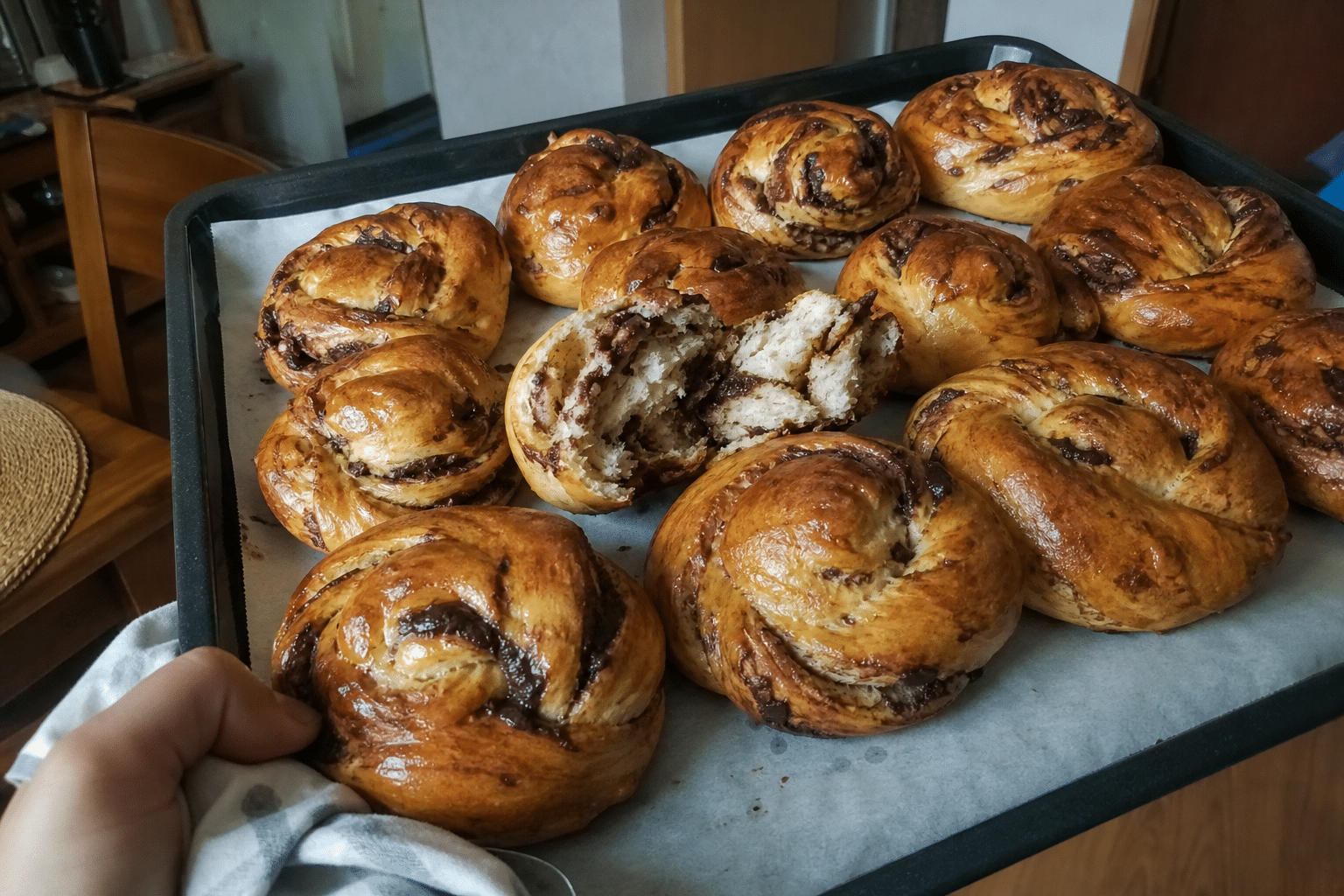

Walk into a Danish bakery on a cold weekend morning and there they are: golden, pull-apart buns with irregular rivers of dark chocolate running through them, their perfume something between vanilla and something spicier, more aromatic. That spice is cardamom – the Nordic baker’s most useful secret – and once you smell it coming out of your own oven, you will not go back.
I’ll be direct: these buns hit exactly what I look for when I bake. The dough is enriched with buttermilk, which keeps the crumb moist and adds just enough tang to balance the sweetness. Cardamom and vanilla carry that unmistakably Scandinavian warmth. And the chocolate – coarsely chopped dark chocolate, kneaded directly into the dough with soft butter – melts into soft, uneven pockets as the buns bake. No two bites are quite the same.
They are also genuinely quick to make. One hour of rising, fifteen minutes in the oven.
Why this recipe works
Buttermilk does two things here. It keeps the crumb tender and pillowy long after the buns cool, and it works with the yeast to create an airy, light texture that a plain water dough does not give you.
The key technique is kneading the chopped chocolate and soft butter directly into the dough by hand rather than folding them in later. This distributes the chocolate evenly so every single bun gets pools of chocolate, not just the lucky ones from the center of the batch.
Ingredients
Makes 15 buns
- Scant 1 cup (200 ml) buttermilk
- Scant 1/2 cup (100 ml) warm water
- 35 g (1.2 oz) fresh yeast, or 1½ packets (about 10 g) instant yeast
- 3 tablespoons (40 g) granulated sugar
- 3 large eggs (2 for the dough, 1 for brushing)
- 3½ cups (450 g) all-purpose flour, plus a few extra tablespoons (25 g) for kneading
- Scant 1 cup (100 g) light rye flour
- 1 teaspoon ground cardamom
- 1 teaspoon vanilla extract (see tip below)
- ½ teaspoon salt
- 3½ tablespoons (50 g) soft butter, cut into small cubes
- 3.5 oz (100 g) dark chocolate, coarsely chopped
Instructions
1. Stir the buttermilk and warm water together in a large bowl. Crumble in the fresh yeast and stir until fully dissolved (if using instant yeast, stir it straight in with the flour in the next step).
2. Add the sugar and 2 of the eggs. Stir to combine.
3. Add both flours, the cardamom, vanilla, and salt. Stir until a rough dough comes together, then turn it out onto a lightly floured surface and knead by hand for a couple of minutes.
4. Scatter the butter cubes and chopped chocolate over the dough. Knead everything together by hand, working the butter and chocolate evenly through until the dough is smooth, supple, and the mix-ins are uniformly distributed. Plan on about 5 minutes of steady kneading.
5. Return the dough to the bowl, cover it, and let it rise at room temperature for 1 hour.
Read more: You don’t need a fresh loaf: 8 stale-bread ideas that beat the original
6. Preheat the oven to 392°F (200°C) on convection/fan setting, or 425°F (220°C) on a conventional setting. Line a baking sheet with parchment paper.
7. Divide the dough into 15 equal pieces and shape each into a round bun. Place them on the prepared baking sheet and let them proof for 15 minutes.
8. Beat the remaining egg and brush it over each bun. Bake for 15 minutes until deep golden. Serve warm.
Tips and variations
On vanilla extract vs. vanilla sugar: The original recipe calls for vaniljesukker, a Danish baking staple sold in small foil sachets – it is essentially sugar blended with dried vanilla. One teaspoon of pure vanilla extract is a direct and seamless substitute.
On fresh vs. instant yeast: Fresh yeast, sold as small compressed blocks, is standard in Denmark but harder to find at US grocery stores. Substitute 1½ packets (about 10 g) of instant yeast, mixed straight into the flour. The dough will still rise in an hour.
On the chocolate: Rough-chopped dark chocolate bars melt into better, more uneven pockets than chocolate chips, which are formulated to hold their shape in the oven. Something in the 60-70% cocoa range gives the right balance of bitterness and sweetness.
On the rye flour: The 100 g of rye flour gives the crumb a slightly nuttier, more complex flavor and a bit more structure. If you do not have rye, substitute the same weight of all-purpose flour – the buns will be slightly softer and plainer but still excellent.
On freezing: These freeze perfectly. Once fully cooled, seal them in a freezer bag. Reheat from frozen in a 300°F (150°C) oven for a few minutes, or briefly in the microwave.