
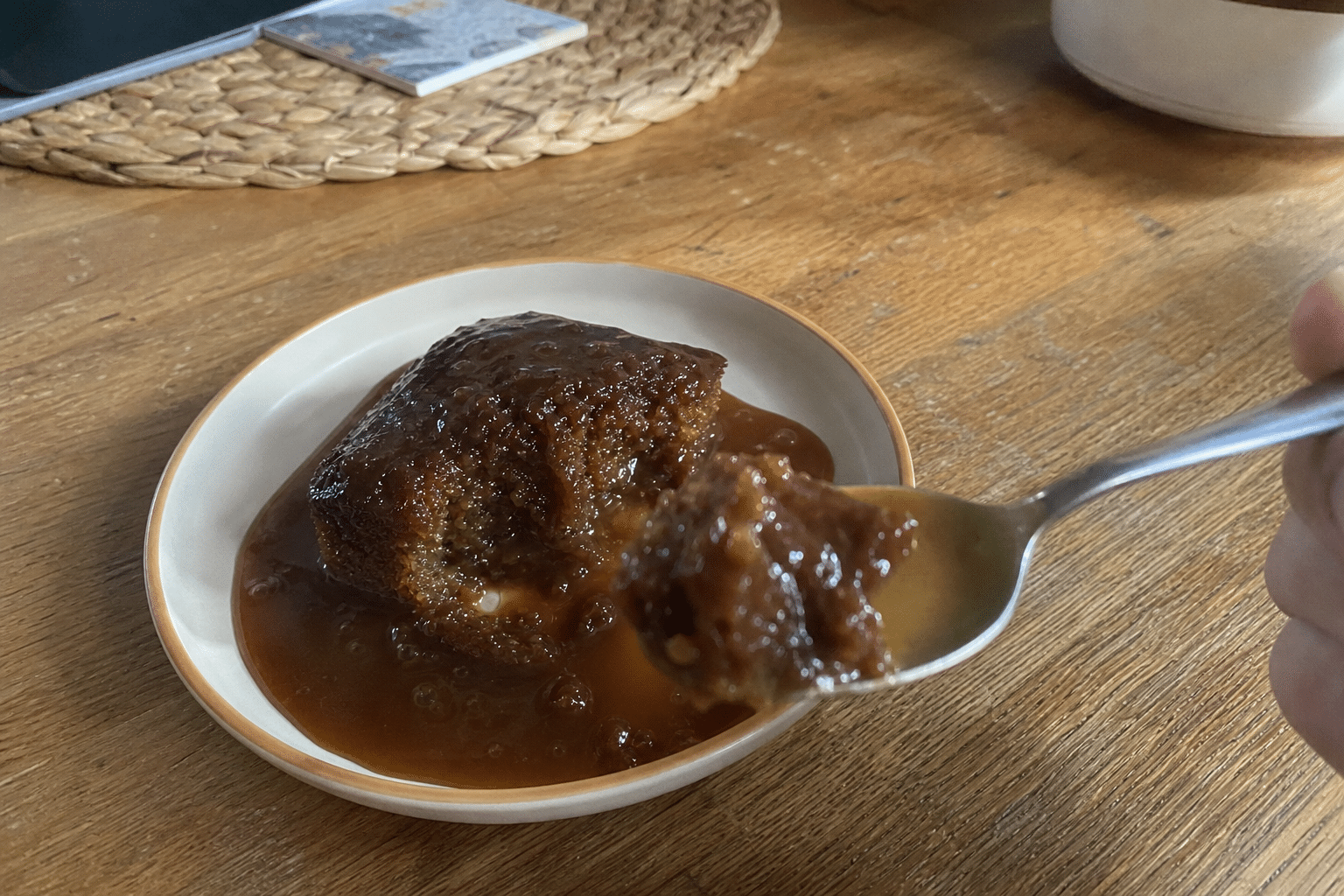

Sticky toffee pudding is a soft, deeply flavored date sponge baked until tender, then soaked in a glossy butter-and-cream toffee sauce. It is served warm, with vanilla ice cream or clotted cream letting the sweetness breathe.
The dessert is closely associated with Cumbria and the Lake District in northwest England. One widely cited account credits chef Francis Coulson, who made it famous at the Sharrow Bay Country House Hotel, reportedly in the 1970s. The origins are contested: one account traces the recipe to a Lancashire hotelier named Patricia Martin, who received it from Canadian servicemen stationed in Britain during World War II and later passed it on to Coulson.
This recipe follows the same approach that has kept sticky toffee pudding on British pub menus and restaurant dessert lists for decades.
Why this recipe works
The dates are the engine. Soaking them in just-boiled water with a pinch of baking soda before they go into the batter is not optional. The heat softens the fruit; the alkaline soda breaks down the fibrous cell walls so the dates dissolve into a thick, dark paste rather than remaining as dense, chewy pieces in the finished sponge.
That paste, together with every drop of the soaking liquid, folds directly into the batter. The result is a crumb that stays moist for days, with a deep caramel-brown color before the sauce ever touches it.
For the sauce, what matters is time. Letting the butter, brown sugar, and cream simmer together for five to seven minutes builds a glossy consistency that clings to each slice rather than running off. Rush it and you get a thin syrup; give it the full simmer and it thickens to coat the back of a spoon.
Read more: You don’t need a fresh loaf: 8 stale-bread ideas that beat the original
Ingredients
For the sponge (serves 8-9, baked in a 9-inch/23 cm square pan):
- 1½ cups (265 g) pitted Medjool dates, roughly chopped
- 1 cup (240 ml) just-boiled water, or strong black coffee
- 1 tsp baking soda
- ½ cup (115 g) unsalted butter, at room temperature
- ¾ cup (150 g) packed dark brown sugar
- 2 large eggs, at room temperature
- 1½ cups (190 g) all-purpose flour
- 1½ tsp baking powder
- ½ tsp fine salt
- 1 tsp vanilla extract
For the toffee sauce:
- ½ cup (115 g) unsalted butter
- 1 cup (200 g) packed dark brown sugar
- 1 cup (240 ml) heavy cream
- 1 tsp vanilla extract
- ¼ tsp fine salt
To serve:
– Vanilla ice cream or clotted cream
Instructions
1. Preheat the oven to 350°F (175°C). Butter a 9-inch (23 cm) square baking pan and line the bottom with parchment paper.
2. Put the chopped dates in a heatproof bowl. Pour the just-boiled water (or coffee) over them and stir in the baking soda. Leave to soak for 20 minutes. The dates will soften and absorb most of the liquid.
3. Mash the soaked dates thoroughly with a fork, or give them a few pulses in a food processor. You want a coarse, thick paste with some texture, not a smooth puree. Set aside along with any remaining soaking liquid.
4. In a large bowl, beat the softened butter and brown sugar together until pale and slightly fluffy, about 3-4 minutes. Add the eggs one at a time, beating well after each addition, then stir in the vanilla.
5. Add the date paste and all its soaking liquid to the butter mixture and stir to combine. The batter will look curdled and uneven at this point – that is expected.
6. Sift in the flour, baking powder, and salt. Fold gently until just combined with no dry streaks remaining. Do not overmix.
7. Pour the batter into the prepared pan and smooth the top. Bake for 30-35 minutes, until the surface springs back when pressed lightly and a skewer inserted into the center comes out with moist, not wet, crumbs.
8. While the sponge bakes, make the sauce. Melt the butter in a medium saucepan over medium heat. Add the brown sugar and stir for about 2 minutes until dissolved. Pour in the heavy cream and bring to a steady simmer. Cook for 5-7 minutes, stirring occasionally, until the sauce thickens to coat the back of a spoon and turns a deep amber color. Remove from heat and stir in the vanilla and salt.
9. When the pudding comes out of the oven, poke it all over with a skewer, making holes about 1 inch (2.5 cm) apart across the whole surface. Pour roughly one-third of the warm sauce over the top and let it soak in for five minutes before cutting.
10. Serve warm, with extra sauce spooned over each portion and a scoop of vanilla ice cream or a spoonful of clotted cream alongside.
Read more: Why homemade garlic-infused oil stored at room temperature is a botulism risk
Tips and variations
Use Medjool dates. They are softer and have a richer, more caramel-like flavor than standard dried Deglet Noor dates. If Medjool dates are unavailable, extend the soak to 30 minutes and chop the dates more finely before soaking.
Coffee instead of water. Replacing the soaking water with a cup of strong black coffee deepens the flavor and adds a slight bitterness that cuts through the sweetness of the sauce. The finished pudding does not taste of coffee.
Individual ramekins. To bake individual portions, butter eight 6-ounce (180 ml) ramekins, divide the batter between them, and bake at 350°F (175°C) for 18-22 minutes, until a skewer comes out clean.
Make-ahead. The baked sponge and the sauce can both be prepared up to two days in advance and refrigerated separately. Warm the sponge in a 325°F (165°C) oven for 10-12 minutes and reheat the sauce gently on the stovetop before serving. The sponge also freezes well for up to two months; thaw overnight in the refrigerator and reheat before serving.
Allergens. This recipe contains gluten, dairy, and eggs. For a dairy-free version, substitute full-fat coconut cream for the heavy cream in the sauce and use a plant-based butter throughout.