
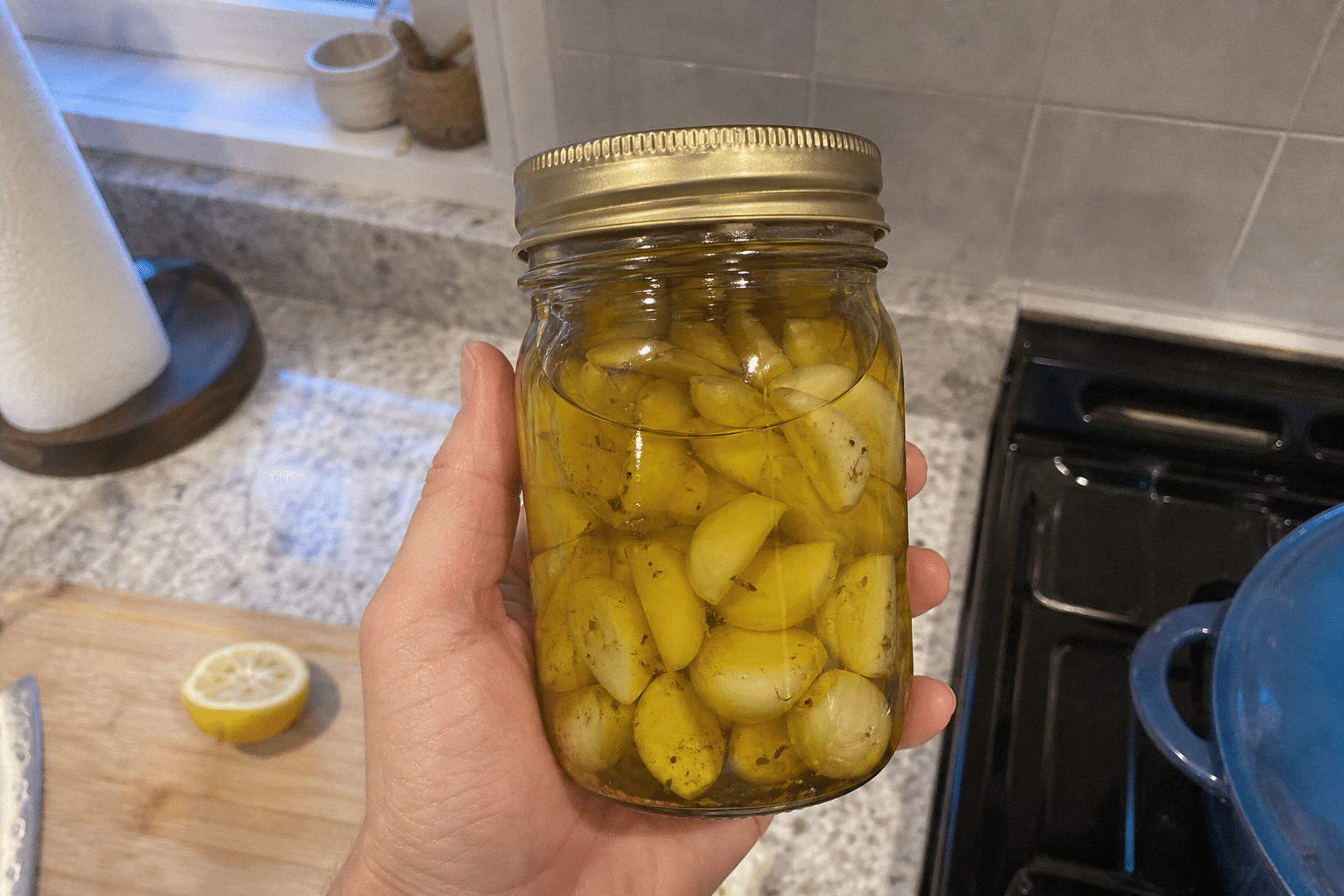

Homemade garlic-infused oil appears in thousands of recipes and social media posts as an easy, flavorful kitchen project. What almost none of those posts mention: a jar left at room temperature can silently produce botulinum toxin with no off smell, no bubbling, and no color change to warn you. The National Center for Home Food Preservation states plainly that “mixtures of garlic in oil stored at room temperature are at risk for the development of botulism.”
The fix is simple. The problem is that most people making this at home do not know the risk exists.
Why oil creates exactly the right conditions for botulism
When garlic cloves are submerged in oil, you create four conditions that Clostridium botulinum needs to germinate its spores and produce toxin. According to Nummer et al. (2011), published in Food Protection Trends, those conditions are: a natural presence of C. botulinum spores, an anaerobic (oxygen-free) environment, a pH above 4.6, and a water activity above 0.85.
Fresh garlic satisfies all four. C. botulinum spores are common in soil and are found on fresh garlic. The oil seals out oxygen, creating the anaerobic pocket the bacteria need. Garlic is a low-acid vegetable with a pH well above 4.6. And fresh garlic contains enough moisture: even very small amounts of water trapped in oil are sufficient to allow microbial growth and botulism toxin formation, the researchers note.
Room temperature makes conditions worse. Mesophilic strains of C. botulinum, the type linked to documented garlic-in-oil outbreaks, are only inhibited at or below 50°F (10°C). A kitchen counter at 68-75°F (20-24°C) falls well within their growth range.
Read more: The best shepherd’s pie: tender lamb in rich gravy, topped with the creamiest mashed potato
No smell, no color change, no warning
This is what makes the hazard so serious: you cannot detect it.
Nummer et al. note that “visual or other organoleptic clues do not provide adequate information to prevent botulism.” A contaminated jar looks, smells, and tastes exactly like a normal jar of garlic oil. Non-proteolytic C. botulinum strains do not produce the signs of spoilage that would prompt you to discard the food.
Botulinum toxin is a neurotoxin. There is no color change, no off odor, no visible film. The only way to know the jar is safe is to have stored it correctly from the start.
Read more: The best homemade apple pie, with a flaky double crust and spiced filling that sets properly
A history of outbreaks and FDA action
The link between garlic-in-oil and botulism is well documented. In 1985, 37 people were sickened after eating a garlic-in-oil preparation at a restaurant, according to Nummer et al. Laboratory investigation that followed confirmed that C. botulinum can survive and produce toxin in garlic-in-oil preparations.
After a second botulism outbreak from garlic-in-oil in 1989, the FDA ordered commercial garlic-in-oil products that contained no acidifying agent removed from store shelves, and required all future commercial preparations to be properly acidified with phosphoric or citric acid before garlic is added to oil.
Despite that action, home-prepared garlic in oil was linked to botulism cases in California in 1991 and in Florida in 1999, the researchers document. By 1999, non-acidified garlic-in-oil mixtures were formally recognized as potentially hazardous in the FDA Food Code. The acidifiers used in commercial products are not practical to replicate at home.
Read more: Buche de Noel from scratch: the Christmas Yule log that looks harder than it is
The two safe storage options
The National Center for Home Food Preservation recommends two approaches:
Refrigerate at 40°F (4°C) or below, and use within 4 days. No reported outbreaks have been traced to garlic-infused oil that was properly refrigerated, according to Nummer et al. The 4-day limit is not arbitrary: at temperatures between 41°F and 50°F (5-10°C), C. botulinum risk increases significantly beyond that window. Because many household refrigerators run warmer than ideal, freezing is considered the safer long-term choice.
Freeze for longer storage. Freezing is the safest single-hurdle option, according to both the NCHFP and Nummer et al. A frozen garlic-oil mixture does not support pathogen growth, and shelf life is then limited only by quality changes. Many oils do not solidify in the freezer, making it easy to scoop out what you need.
How to freeze garlic-infused oil
The NCHFP recommends using glass freezer jars or plastic freezer boxes. Leave 1/2 inch (about 1.5 cm) of headspace to allow for expansion. Label each container with the date before freezing. Frozen garlic-in-oil will keep for several months.
Once thawed, treat it the same as freshly made: keep it refrigerated and use it within 4 days.