
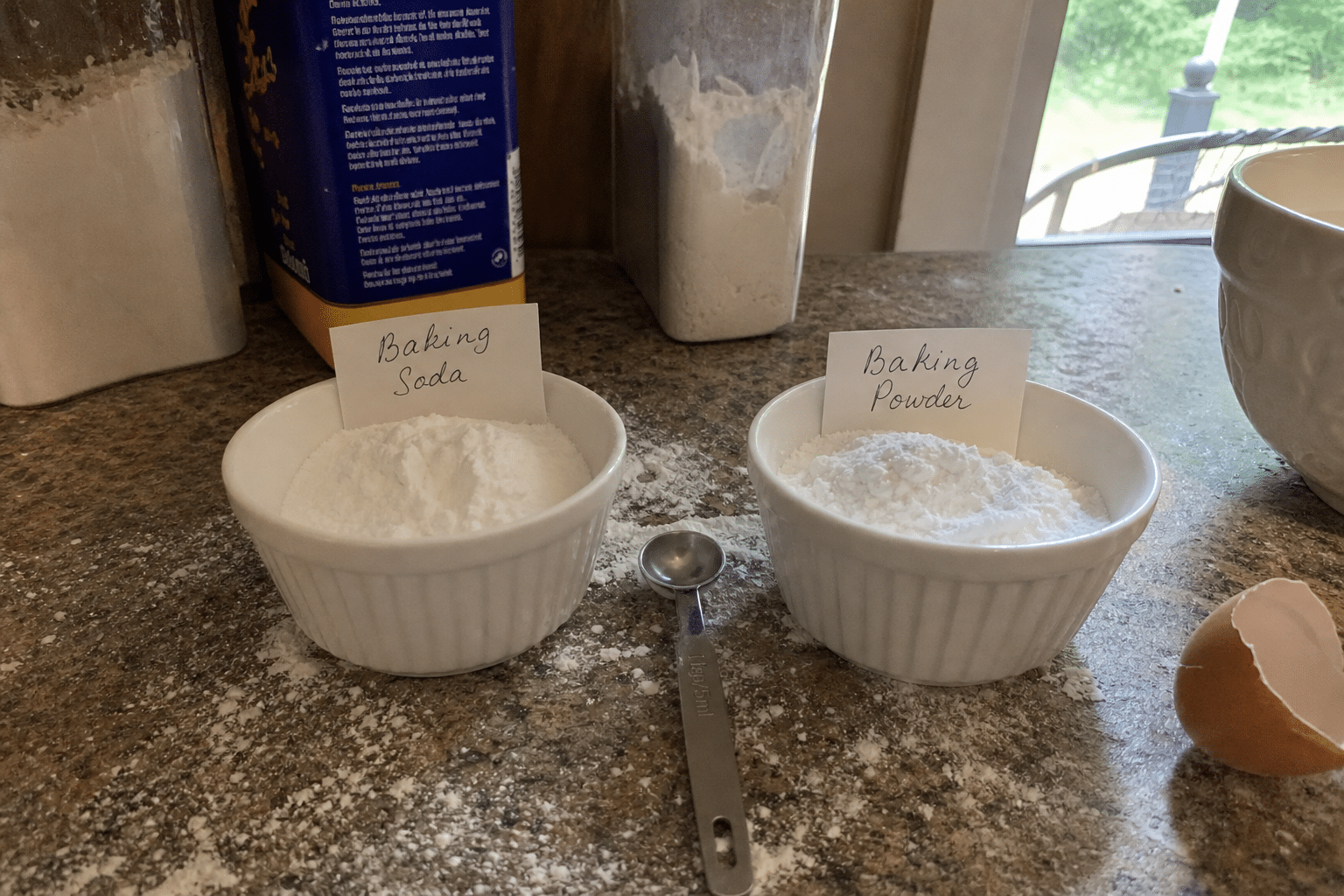

The two white powders look identical in an unlabeled jar and often sit in the same cabinet, but their chemistry is fundamentally different. A straight one-for-one swap changes the rise, the flavor, and the color of whatever you are baking. Here is what food scientists say about how each one works, and what to do when you run out of one mid-recipe.
Baking soda is a single compound that needs a recipe acid
Baking soda is pure sodium bicarbonate, also called sodium hydrogen carbonate. It has one job: when it meets moisture and an acid, it releases carbon dioxide bubbles that make batter rise. Without both of those triggers, nothing happens.
The acid must already be somewhere in your recipe. Common activating acids include buttermilk, sour cream, yogurt, lemon juice, natural (not Dutch-process) cocoa powder, and brown sugar, which contains acidic molasses. If a recipe calls for baking soda but none of those ingredients appear on the list, read it again carefully.
Baking powder is a self-contained leavener
Baking powder packs three ingredients in one container: sodium bicarbonate, a dry acid (usually cream of tartar), and a starch from corn, rice, or wheat. The starch absorbs ambient moisture and, as University of Tasmania food scientists explain, “prevents the acid and base from reacting prematurely in the pantry.”
Because baking powder already contains its own acid, it only needs moisture to activate. Most grocery store baking powder is double-acting: it releases a small amount of carbon dioxide when it first hits liquid in the bowl, then delivers the larger burst when oven heat is applied. That second rise is where layer cakes get their height.
Read more: The classic French onion soup that actually tastes like the restaurant version, made at home
The potency gap: three teaspoons of powder per one of soda
Baking soda is roughly three to four times stronger than baking powder as a leavener. The gap exists because baking powder’s leavening capacity is spread across its three-ingredient mix, diluted by the acid and starch.
The practical substitution ratio is 3 to 1: for every 1 teaspoon of baking soda a recipe calls for, substitute 3 teaspoons (1 tablespoon) of baking powder. The reverse works too: replace 1 teaspoon of baking powder with 1/4 teaspoon of baking soda plus 1/2 teaspoon of cream of tartar.
One point to keep in mind when substituting: do not remove the buttermilk, yogurt, lemon juice, or other acid from the original recipe. Those ingredients carry flavor, moisture, and texture the finished product depends on.
Read more: Osso buco with saffron risotto and gremolata: the Italian braise that is easier than it looks
Baking soda boosts browning
One overlooked advantage of baking soda over baking powder is color. According to University of Tasmania food scientists, “baking soda can also increase the surface browning of food by enhancing the Maillard reaction.” The Maillard reaction is the cascade of chemical changes responsible for the crust on seared meat, the color of a pretzel, and the snap on a chocolate chip cookie.
Baking soda’s alkaline nature speeds that reaction, producing deeper browning at lower temperatures. This is part of why many cookie recipes call for baking soda even when the dough is not especially acidic; the browning is part of the formula.
Which leavener belongs in which recipe
Recipe | Leavener | Why |
|---|---|---|
Chocolate chip cookies | Baking soda | Brown sugar and natural cocoa supply the acid; soda adds color |
Buttermilk pancakes | Baking soda | Buttermilk is the activating acid |
Vanilla layer cake | Baking powder | No acidic ingredient; powder activates on liquid alone |
Biscuits and scones | Baking powder | Neutral lift without added tang |
Red velvet cake | Both | Cocoa and buttermilk present, but soda alone would leave excess base |
Banana bread with sour cream | Both | Acid present, but not enough to leaven full volume |
According to Bob’s Red Mill, baking soda is best suited to “cookie and muffin recipes” where strong leavening and browning are both welcome, while baking powder’s built-in acid buffer gives a “more neutral taste” that suits cakes and bread.
Read more: You don’t need to rinse it: 7 foods you are washing that you really shouldn’t
The soapy taste problem
If baking soda is not fully neutralized by the recipe’s acid, leftover sodium carbonate stays in the finished bake. The result is a soapy or metallic off-flavor that no glaze covers up. Baking powder avoids this by design, since its built-in acid is calibrated to match its built-in base.
If a cake or muffin smells faintly of soap coming out of the oven, unreacted baking soda is the most likely cause. The fix is to reduce the amount of soda or confirm the recipe has an acidic ingredient to match it.
How to tell if yours is still active
Both leaveners expire and lose potency when exposed to moisture over time, as Bob’s Red Mill notes.
To test baking powder: stir a small amount into hot water, active powder bubbles strongly. To test baking soda: drop a small amount into white vinegar. No fizz means the container needs replacing before your next bake.