
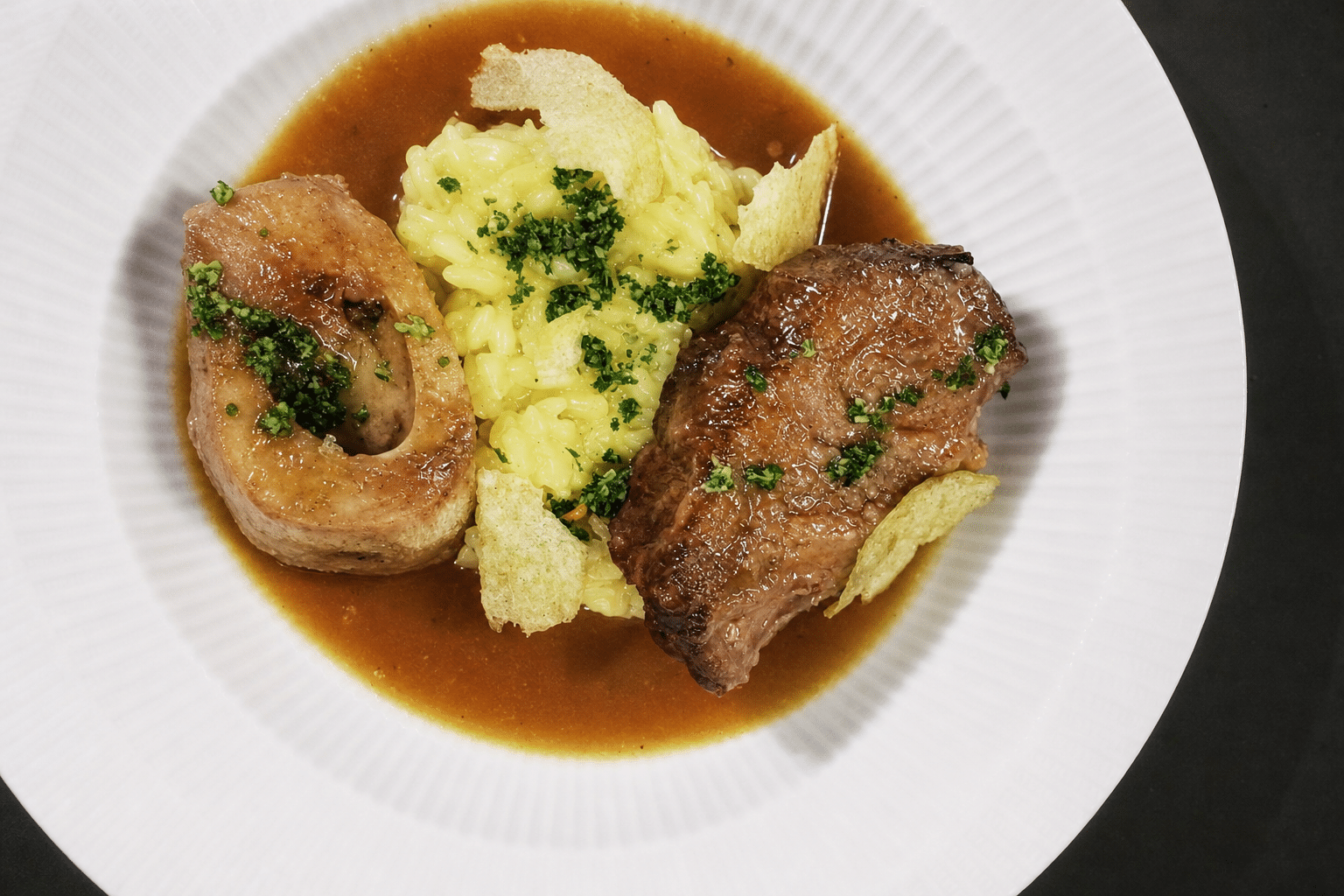

Osso buco is one of those dishes that sounds far more demanding than it actually is. The name alone suggests a culinary challenge, but once the meat is in the pot, it honestly takes care of itself most of the time and comes out tasting absolutely wonderful.
This recipe pairs slow-braised beef shank with risotto alla Milanese, the classic saffron-scented version, and a sharp gremolata of garlic, parsley, and lemon zest that cuts right through the richness. Three components, one seriously impressive plate.
Why this recipe works
The long braise is the whole point. With 2.5 to 4 hours of gentle heat and liquid, the beef shank transforms from tough to deeply tender. The vegetables and flour that go into the braising liquid do double duty as a natural sauce thickener once blended.
For the risotto, the key is patience: add the stock one ladleful at a time and let each addition absorb almost completely before adding more. Saffron goes in near the end so its flavor stays bright. A small knob of cold butter stirred in off the heat gives the risotto that glossy, restaurant-style finish.
Read more: You don’t need to rinse it: 7 foods you are washing that you really shouldn’t
The gremolata is not a garnish you can skip. Its raw punch of lemon zest, parsley, and garlic is what lifts the whole dish and keeps the richness from feeling heavy.
Ingredients
For the osso buco
- 1 or 2 beef shank cross-cuts, about 1.2 to 1.5 inches (3 to 4 cm) thick
- 1 tablespoon all-purpose flour
- Salt
- 2 teaspoons (10 g) butter
- 1 tablespoon olive oil
- 2 teaspoons (10 g) tomato paste
- 1 medium onion
- 2 carrots
- 1¼ cups (300 ml) red wine
- 1⅔ cups (400 ml) water
- 1 beef bouillon cube
- Salt and freshly ground black pepper
- Lemon juice and balsamic vinegar, to finish
- 3 tablespoons (50 ml) heavy cream (optional)
For the risotto alla Milanese
- 3 tablespoons (40 g) butter, divided
- Marrow from the beef shank bone (optional)
- 1 shallot, finely diced
- ¾ cup (160 g) Arborio rice
- Scant ½ cup (100 ml) dry white wine
- 2½ cups (600 ml) warm beef stock
- A generous pinch of saffron threads
- Generous ⅓ cup (35 g) freshly grated Parmesan
- Salt, lemon juice, lemon zest, and balsamic vinegar, to taste
For the gremolata
- 2 garlic cloves
- ½ bunch flat-leaf parsley
- Zest of ½ organic lemon
Instructions
Start the osso buco
- Using a sharp knife or kitchen scissors, cut a few small slashes through the sinew running around the edge of each shank. This stops the meat from buckling and searing unevenly.
- Mix the flour and a generous pinch of salt on a small plate and coat the meat on both sides.
- Heat the butter and olive oil in a Dutch oven or heavy pot over medium-high heat. Sear the shank until deeply browned on both sides.
- When you flip the meat, push it to one side and add the tomato paste directly to the hot pan. Let it cook undisturbed for about a minute to caramelize, then stir it into the pan juices.
- Peel and roughly chop the onion and carrots. Add them to the pot and cook for a few minutes until they pick up a little color.
- Pour in the red wine and water, then crumble in the bouillon cube. The meat and vegetables should be covered; add a splash more water if needed.
- Put the lid on, reduce the heat to low, and step away. The meat needs a minimum of 2.5 hours, but 4 hours is even better.
Make the gremolata
- Rinse the parsley and dry it thoroughly.
- Using a fine grater, zest half the lemon, being careful to avoid the bitter white pith.
- Peel the garlic cloves and cut each into a few rough pieces.
- Combine the parsley, lemon zest, and garlic and either chop everything finely with a knife or blitz briefly in a mini food processor until well mixed. Set aside.
Make the risotto
- Keep your beef stock warm in a small saucepan over low heat.
- Melt 2 tablespoons (30 g) of the butter in a wide, heavy-bottomed pan over medium-low heat. If you are using the marrow scooped from the shank bone, add it here and let it melt.
- Add the shallot and cook gently until completely soft and translucent. Do not let it brown.
- Pour the entire contents of the pan through a fine-mesh strainer into a bowl. Return only the strained fat to the pan and discard the solids. Add the rice to the fat.
- Toast the rice over medium heat, stirring, until the grains look translucent and glossy, about 2 minutes.
- Add the white wine and stir until it has fully evaporated.
- Add the warm stock about scant ½ cup (100 ml) at a time, stirring after each addition and waiting until it has nearly absorbed before adding more. Continue until the rice is creamy and cooked through with just a slight bite, about 20 minutes total.
- With a couple of minutes of cooking left, add the saffron and stir it through. Let it cook into the risotto for those last few minutes.
- Turn off the heat. Stir in the Parmesan and the remaining 2 teaspoons (10 g) of cold butter. Taste and adjust with a little salt, a squeeze of lemon juice, a pinch of lemon zest, or a splash of balsamic vinegar. Let the risotto rest for a minute or two before serving.
Finish the sauce and serve
- Lift the braised shank out of the pot and set it aside. Blend the braising liquid and vegetables with an immersion blender until smooth. If the sauce feels thin, reduce it over medium heat for a few minutes.
- Season the sauce with salt, black pepper, a splash of balsamic vinegar, and a little lemon juice. Stir in the cream if you want a richer finish.
- Spoon the risotto onto one side of a warm plate. Place the shank alongside it and ladle the sauce generously over the meat. Scatter the gremolata over the top and serve immediately.
Tips and variations
One thick slice or two thinner ones? My piece was about 1.5 inches (4 cm) thick and dry-aged for 60 days, so one slice served two people comfortably. For standard beef shank from the grocery store, plan on one to two slices per person at around 1.2 inches (3 cm) thick.
Read more: You don’t need an air fryer: 8 crispy foods your oven already does better
Stovetop or oven: This recipe works perfectly on the stovetop, but finishing the braise in a 325°F (160°C) oven with the lid on gives more even, all-around heat and reduces any risk of scorching.
Make it ahead: The braised shank and sauce actually improve overnight as the flavors settle. Refrigerate the meat in its sauce and reheat gently. Make the risotto fresh just before serving.
Read more: Koketter: the Danish baked egg cups that make weekend brunch feel like a restaurant in 20 minutes
Veal vs. beef: Traditional osso buco is made with veal shank. If your butcher has it, it works beautifully here and cooks a bit faster. Beef shank is an excellent substitute and much easier to find at most grocery stores.
Risotto rescue: If the risotto stiffens up between cooking and serving, stir in a splash of warm stock to loosen it back to a creamy consistency.