
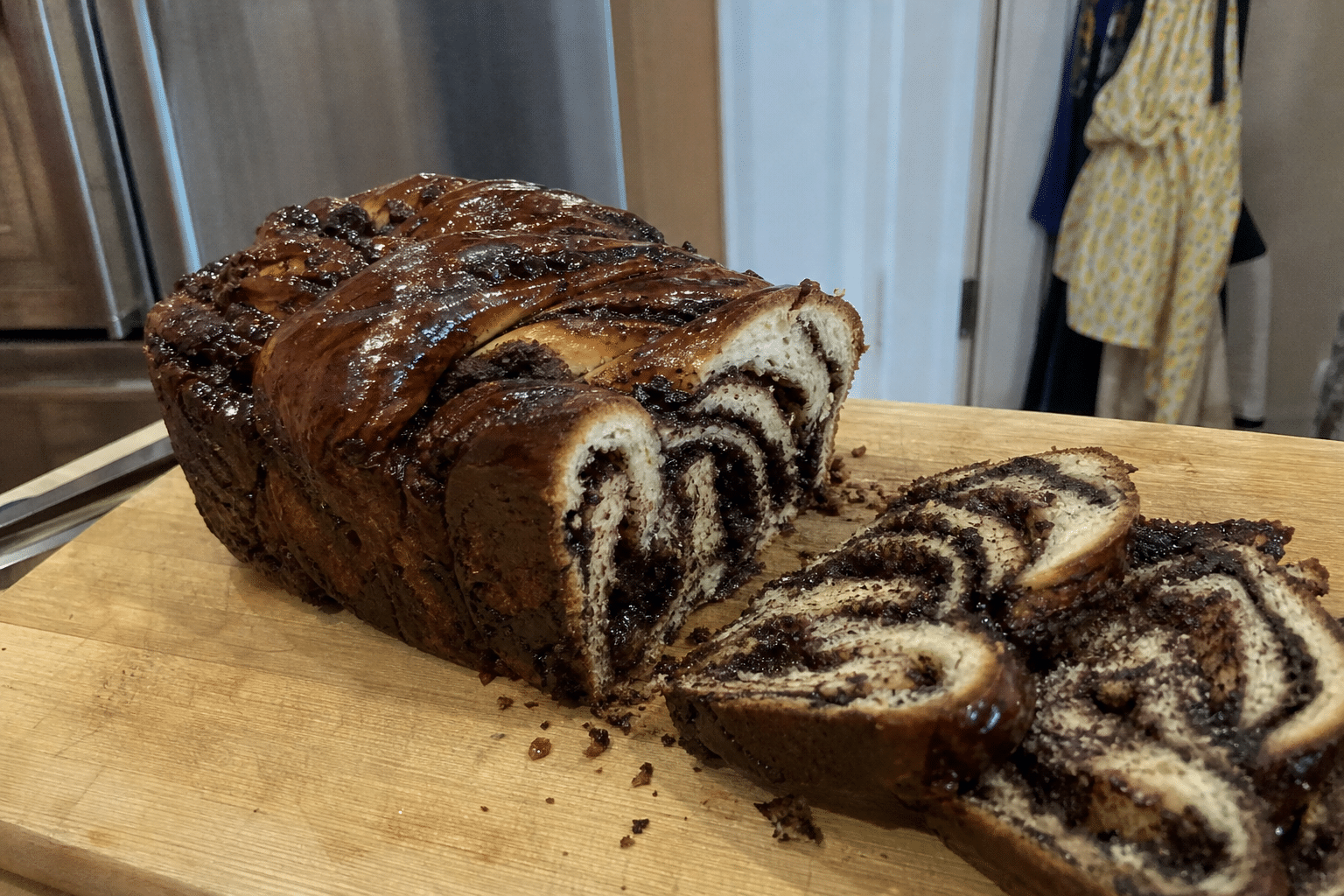

Babka is a Jewish Eastern European enriched bread with roots in Polish and Ukrainian home baking, where leftover challah dough was rolled with a sweet filling. The chocolate version became a fixture in New York’s Jewish bakeries and has since crossed into mainstream baking culture, where its dramatic spiral cross-section makes it one of the most-photographed breads of the holiday season. With Hanukkah falling in early December, November is the right moment to learn it.
This recipe produces one loaf: a golden, pull-apart bread with a rich, dark filling made from real chocolate and butter. The dough starts the night before – not because babka is difficult, but because cold, slow fermentation is what gives it both the flavor and the structure to work with well.
Why this recipe works
Enriched doughs – those with high butter and egg content – are soft, sticky, and hard to roll at room temperature. Chilling the dough overnight firms the butter, making it much easier to roll thin without tearing, and gives the yeast time to develop flavor slowly. The result has better taste and better structure than any same-day version.
The filling uses cocoa powder alongside the melted chocolate. This thickens the mixture as it cools, giving you a paste that spreads cleanly without pooling or running when the dough rolls up. Liquid filling means messy layers and a gooey bottom; this filling stays put.
Cutting the rolled log in half lengthwise and twisting the two pieces together – cut sides facing up – is what creates the layered cross-section babka is known for. The technique itself takes about two minutes.
Ingredients
For the dough:
- 2 1/4 cups (280g) all-purpose flour, plus more for dusting
- 2 1/4 teaspoons (7g) instant yeast
- 3 tablespoons (38g) granulated sugar
- 1/2 teaspoon fine salt
- 2 large eggs, room temperature
- 1/4 cup (60ml) whole milk, warmed to about 100°F (38°C)
- 1/2 teaspoon vanilla extract
- 6 tablespoons (85g) unsalted butter, softened, cut into 1-tablespoon pieces
For the filling:
- 4 oz (115g) dark chocolate (60-70% cacao), finely chopped
- 4 tablespoons (57g) unsalted butter
- 3 tablespoons (23g) powdered sugar
- 2 tablespoons (12g) unsweetened cocoa powder
- Pinch of fine salt
For the syrup:
- 1/4 cup (50g) granulated sugar
- 1/4 cup (60ml) water
Equipment: one 9×5 inch (23x13cm) loaf pan, greased
Instructions
Day 1: Make the dough
1. Combine the flour, yeast, sugar, and salt in the bowl of a stand mixer fitted with a dough hook and whisk briefly to combine.
2. Add the eggs, warm milk, and vanilla. Mix on low until the dough just comes together, about 2 minutes, then increase to medium and knead until smooth and no longer sticking to the bowl sides, about 5 minutes.
Read more: The Japanese flour-roux trick that makes homemade sandwich bread stay soft for days
3. With the mixer on medium-low, add the butter one tablespoon at a time, waiting until each piece is fully absorbed before adding the next. The dough will look rough and stringy at first – keep going. Once all the butter is in, increase speed to medium and mix for 5 more minutes, until the dough is smooth, glossy, and stretchy. It should be soft and slightly tacky but not aggressively sticky.
4. Turn the dough onto a lightly floured surface, shape into a ball, and place in a greased bowl. Cover tightly and refrigerate for at least 8 hours and up to 16 hours.
Day 2: Fill, twist, and bake
5. Make the filling: melt the chocolate and butter together in a heatproof bowl set over a pan of barely simmering water, stirring until smooth. Remove from heat. Stir in the powdered sugar, cocoa powder, and salt until fully combined. Set aside at room temperature until the mixture thickens to the consistency of thick peanut butter – about 30 to 45 minutes. It must be spreadable, not liquid.
6. Remove the dough from the refrigerator and let it rest for 10 minutes. On a lightly floured surface, roll it into a rectangle roughly 12 by 16 inches (30 by 40cm), with the long edge facing you.
7. Spread the filling evenly over the dough, leaving a 1/2-inch (1cm) border along the far long edge.
8. Starting from the long edge closest to you, roll the dough tightly away from you into a log. Pinch the seam firmly to seal.
Read more: The Thanksgiving sweet potato pie that holds its own against pumpkin
9. Using a sharp knife, cut the log in half lengthwise, all the way through. You now have two long halves with the spiral layers exposed on the cut surfaces.
10. Lay the halves parallel to each other with cut sides facing up. Pinch the top ends together, then twist the two halves around each other two or three times, keeping the cut surfaces facing up throughout. Pinch the bottom ends to seal.
11. Transfer the twisted loaf to the prepared pan – some filling will escape; tuck it back into the folds where you can. Cover loosely and let rise at room temperature until noticeably puffier, 2 to 3 hours. Because the dough is cold from the fridge, this rise takes longer than it would from a warm dough.
12. Heat the oven to 350°F (175°C). Bake for 35 to 40 minutes, until the top is deep golden brown. If the loaf browns quickly, tent loosely with foil after 25 minutes.
13. While the babka bakes, make the syrup: combine the sugar and water in a small saucepan over medium heat, stirring until the sugar dissolves. Bring to a brief boil, then remove from heat.
14. The moment the babka comes out of the oven, brush all the syrup over the top. Use every drop. Let the loaf cool in the pan for 20 minutes before turning out onto a rack.
Read more: A gingerbread bundt cake that makes the whole house smell like Christmas, done in under an hour
Tips and variations
Don’t skip the syrup. An enriched loaf like this dries out within hours without a glaze. The syrup seals in moisture and gives the crust a lacquered finish. Brush it on hot so it absorbs rather than pooling on the surface.
No stand mixer. The dough can be made by hand, but incorporating butter into a soft wet dough takes effort. Work on an unfloured surface: flatten the dough, smear butter across it with the heel of your hand, fold it back, and repeat. Budget 15 to 20 minutes of this process before the butter is fully integrated and the dough turns smooth.
Filling variations. Add 1 teaspoon of espresso powder to the filling for depth. For a hazelnut note, fold in 2 tablespoons of chocolate-hazelnut spread once the base mixture has cooled. A half-teaspoon of cinnamon is traditional and pairs well with the dark chocolate.
Make-ahead. After step 11, instead of rising at room temperature, cover the pan and refrigerate overnight. Bake straight from the fridge the next morning, adding 10 to 15 minutes to the baking time.
Storage. Babka keeps well wrapped at room temperature for 2 to 3 days. To freeze, cool completely, slice the loaf, wrap individual slices, and freeze for up to one month. Reheat a slice in a 300°F (150°C) oven for 8 minutes.
Allergens: Contains gluten, eggs, and dairy. Most commercial dark chocolate also contains soy lecithin. For a dairy-free version, use a neutral plant-based butter and dairy-free dark chocolate throughout.