
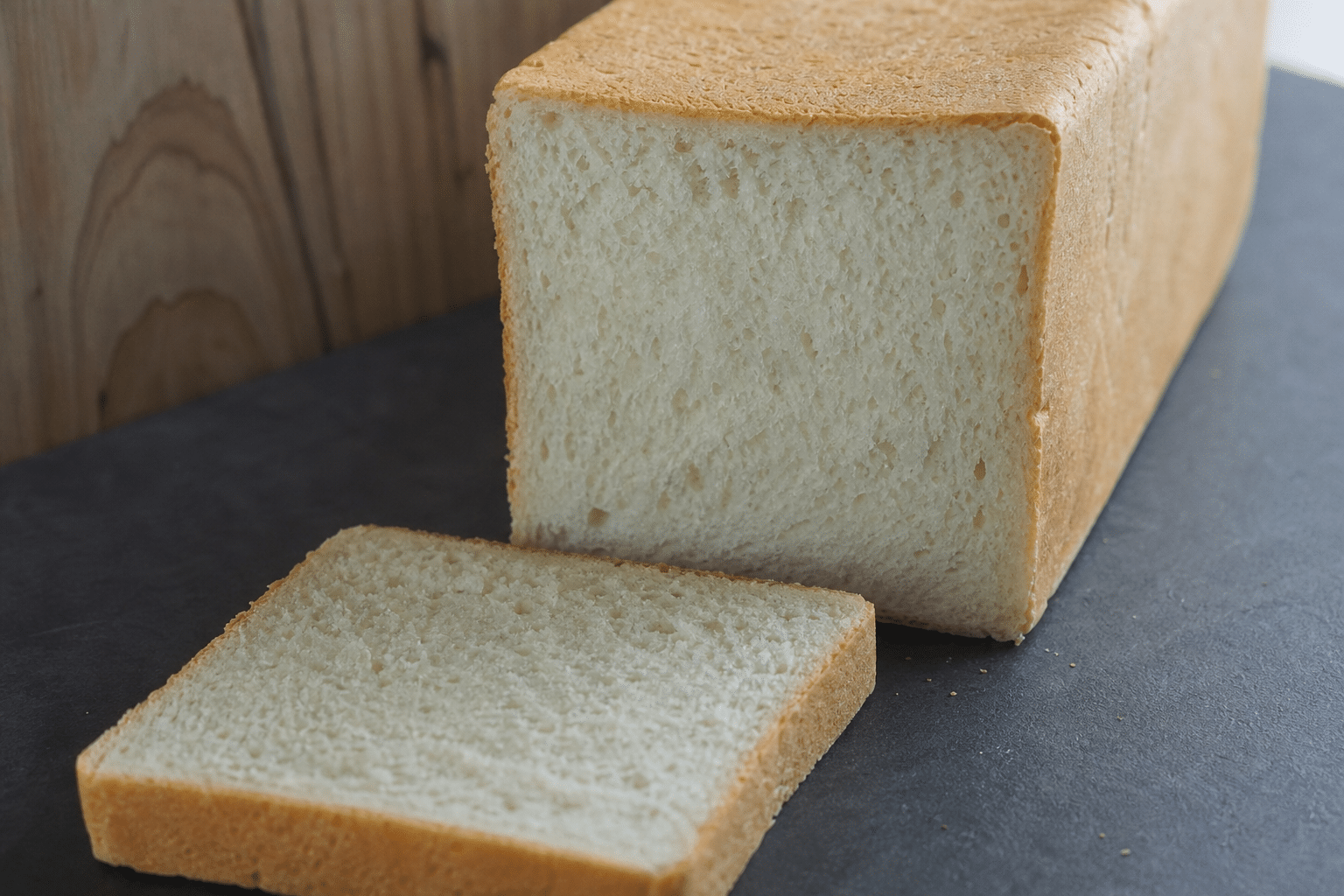

This is my airiest, most delicious sandwich bread to date, and the secret is a technique called tangzhong. You cook a small portion of the flour and milk together into a thick roux before you build the dough. That cooked paste traps extra moisture inside the starch, and the result is a loaf with a soft, tender crumb that holds up long after the first slice.
I had already used tangzhong in a batch of dinner rolls and loved what it did, so applying it to my standard sandwich bread felt like the obvious next step. What I didn’t expect was just how remarkable the difference would be.
What tangzhong actually does
When flour and liquid are heated together above roughly 150°F (65°C), the starch granules absorb the liquid and swell in a process called gelatinization. That gelatinized starch holds onto moisture far more tightly than raw flour does, so more water stays locked inside the loaf during baking and throughout storage. The crumb stays moist and soft without going gummy, and the bread resists staling noticeably longer than a standard white loaf.
Ingredients
Tangzhong roux:
- 3/4 cup plus 1 tablespoon whole milk (200 ml)
- 1/3 cup all-purpose flour (40 g)
Bread dough:
- 25 g fresh yeast (see Tips for active dry yeast substitution)
- 1 tablespoon sugar
- 1 tablespoon coarse salt
- 2 tablespoons neutral oil
- just over 2 cups lukewarm water (500 ml)
- 5 1/2 to 6 1/2 cups all-purpose flour (700 to 800 g), plus a little more as needed
- 2 tablespoons (25 g) softened unsalted butter, for greasing the pan
Instructions
1. Make the tangzhong. Whisk the milk and flour together in a small saucepan until completely smooth. Set over medium heat and cook, whisking occasionally, until the mixture thickens into a soft, pudding-like paste, about 5 minutes. Scrape into a bowl and refrigerate until cooled to room temperature (around 68°F / 20°C) before proceeding.
2. Build the dough. Add the yeast, sugar, salt, oil, lukewarm water, and the cooled tangzhong paste to the bowl of a stand mixer. With the dough hook on low, add the flour gradually. Once all the flour is incorporated, increase to medium speed and knead for 10 to 15 minutes, until the dough is smooth, elastic, and pulls away cleanly from the sides of the bowl.
Read more: The Thanksgiving sweet potato pie that holds its own against pumpkin
3. First rise. Cover the bowl with a clean kitchen towel and let the dough rise for 30 minutes at room temperature.
4. Shape. Turn the dough out and knead it briefly by hand to release air. Roll it into a tight log, then divide the log into four equal pieces. Rotate each piece 90 degrees so the spiral cut end faces upward, then nestle the four pieces snugly into a well-buttered Pullman loaf pan (the rectangular tin with a sliding lid, ideal for a perfectly square, even-sided sandwich loaf). Butter the inside of the lid generously as well.
5. Second rise and preheat. Slide the lid on and let the loaf rise for about 30 minutes while you preheat the oven to 480°F (250°C) on the convection/fan setting.
Read more: A gingerbread bundt cake that makes the whole house smell like Christmas, done in under an hour
6. Bake. Bake at 480°F with the lid on for 10 minutes, then reduce the oven to 400°F (200°C) and bake for another 20 minutes.
7. Unmold right away. The moment the bread is done, slide off the lid and tip the loaf out of the pan immediately. Leaving it in the pan traps steam underneath, which softens the crust. Get it onto a wire rack straight away.
Tips and variations
The pan. A Pullman loaf pan (also sold as a pain de mie pan) is what you want here. The lidded, straight-sided tin gives you a compact, non-crumbly crumb with clean edges, exactly right for sandwich slices. Grease both the pan and the inside of the lid thoroughly with softened butter.
Read more: The cheap Italian one-pot that beats most restaurant pasta
Yeast. The recipe uses 25 g of fresh yeast, which you can find in the refrigerated section of well-stocked grocery stores. If you can only find active dry yeast, dissolve 2 1/4 teaspoons (7 g) in a splash of the lukewarm water and let it sit for five minutes before adding it to the mixer.
Adding flour. Add it gradually and stop when the dough is smooth and clears the bowl. The right amount falls somewhere between 700 and 800 g depending on your flour and the humidity in your kitchen; don’t pour it all in at once.
Storage. Wrap the completely cooled loaf in a clean cloth or beeswax wrap rather than plastic (plastic makes the crust soft). It stays noticeably fresh for several days.
Next step. I’m already planning to try the tangzhong method on a French bread dough. The technique works so well here that I can’t see a reason not to.