
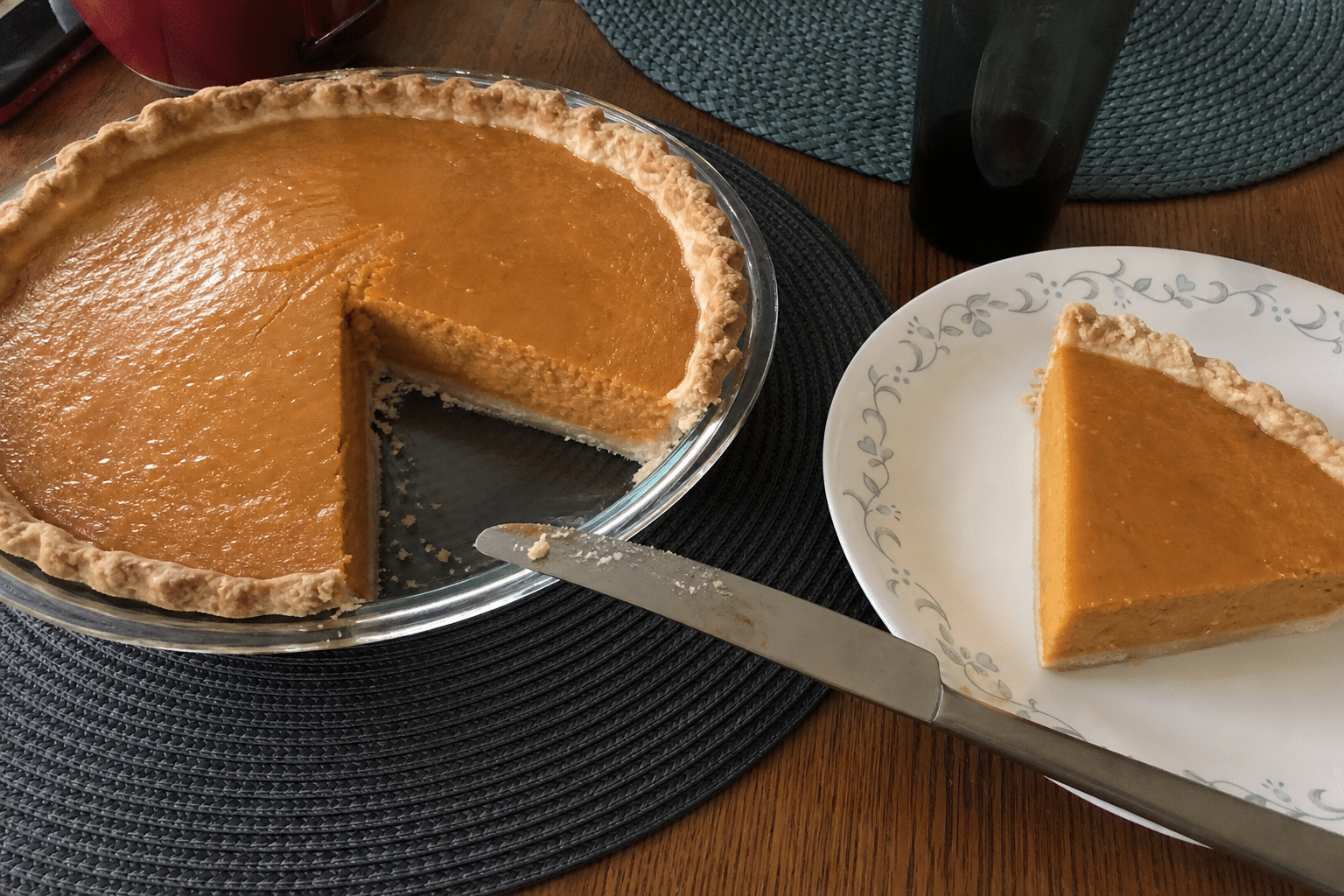

Sweet potatoes are still in season through November across much of the country, and their natural sweetness concentrates when you roast them before pureeing. That single step, roasting rather than boiling, is what separates a pie with flat, one-dimensional filling from one with real depth and a faint caramelized edge.
This recipe builds everything from scratch: a flaky all-butter crust, a smooth spiced custard filling, and a clear guide to knowing when it is done. It serves 8 and needs about 3½ hours of prep and baking, plus a 2-hour cooling period before cutting, most of that is hands-off time.
Why this recipe works
Roasting beats boiling for flavor. When you boil sweet potatoes, water gets in and flavor leaches out. The flesh turns saturated and bland. Roasting does the opposite: the heat drives out moisture and intensifies the sugars, giving the puree a slightly deeper, almost honeyed quality that shows up clearly in the finished pie.
Cinnamon leads, everything else supports. The filling uses cinnamon as the main spice, with ginger, nutmeg, and allspice in smaller amounts. Each adds a different kind of warmth, but the proportions keep cinnamon in front. More than half a teaspoon of any single secondary spice pushes the flavor muddled and sometimes bitter.
An internal thermometer removes the guesswork. The jiggle test is a useful indicator, but ovens vary and so does the moisture level of the puree. The USDA sets 160°F (71°C) as the safe minimum internal temperature for egg-based dishes including custard. Hitting that number at the center means the pie is both done and food-safe. The slight wobble you see at that point firms up completely as the pie cools.
Read more: A gingerbread bundt cake that makes the whole house smell like Christmas, done in under an hour
Ingredients
For the crust:
- 1 1/4 cups (160 g) all-purpose flour
- 1 tablespoon granulated sugar
- 1/2 teaspoon salt
- 1/2 cup (113 g) cold unsalted butter, cut into 1/2-inch cubes
- 3 to 4 tablespoons ice water
For the filling:
- 2 medium sweet potatoes (about 1 1/2 pounds / 680 g total)
- 3/4 cup (150 g) packed light brown sugar
- 2 large eggs
- 1/2 cup (120 ml) heavy cream
- 2 tablespoons unsalted butter, melted
- 1 teaspoon pure vanilla extract
- 1 teaspoon ground cinnamon
- 1/2 teaspoon ground ginger
- 1/4 teaspoon ground nutmeg
- 1/4 teaspoon ground allspice
- 1/2 teaspoon salt
Instructions
1. Roast the sweet potatoes. Preheat oven to 400°F (205°C). Pierce each sweet potato several times with a fork and set on a foil-lined baking sheet. Roast until completely tender, 50 to 60 minutes: a knife should slide through with no resistance. Let cool enough to handle, then scoop out the flesh. You need about 1 1/2 cups (360 ml) of mashed sweet potato.
2. Make the crust dough. Whisk flour, granulated sugar, and salt together in a large bowl. Add the cold butter cubes and work them in with your fingertips or a pastry cutter until the mixture looks like coarse crumbs with a few pea-sized pieces. Add ice water one tablespoon at a time, stirring with a fork after each addition, until the dough just holds together when pinched. Do not overwork it. Shape into a flat disk, wrap tightly, and refrigerate for at least 30 minutes.
3. Roll and par-bake the crust. Reduce oven to 375°F (190°C). On a lightly floured surface, roll the dough into a 12-inch (30 cm) circle, about 1/8 inch (3 mm) thick. Fit into a 9-inch (23 cm) pie pan, fold the overhanging edge under to form a thick rim, and crimp. Line with parchment paper and fill with pie weights or dried beans. Bake 15 minutes, then remove the weights and parchment and bake 5 more minutes, until the bottom looks dry and barely golden.
4. Make the filling. Reduce oven to 350°F (175°C). Puree the sweet potato flesh in a food processor until completely smooth. For the silkiest result, push it through a fine-mesh strainer before proceeding. Add the brown sugar, eggs, heavy cream, melted butter, vanilla extract, cinnamon, ginger, nutmeg, allspice, and salt. Process or whisk until smooth and evenly combined.
Read more: The cheap Italian one-pot that beats most restaurant pasta
5. Fill and bake. Pour the filling into the par-baked crust. Bake at 350°F (175°C) for 50 to 60 minutes, until the outer edge of the filling is fully set and the center still has a small, slow wobble when you gently shake the pan. Confirm doneness with an instant-read thermometer pushed into the center: the filling must reach 160°F (71°C), the USDA minimum safe internal temperature for egg-based custard.
6. Cool before cutting. Transfer to a wire rack and cool for at least 2 hours before slicing. The custard continues to firm as it cools; slicing into a warm pie gives a runny center even when it is fully baked.
Tips and variations
Canned sweet potato works. Use 1 1/2 cups (about 360 g) of plain canned sweet potato puree in place of the roasted fresh sweet potatoes and skip step 1. The flavor will be less intense, but it cuts about an hour off the process.
Read more: The classic key lime pie from scratch: tart, creamy, and easier than you think
Evaporated milk instead of heavy cream. An equal amount of evaporated milk (not sweetened condensed) gives a slightly lighter but still well-set custard.
Make ahead. The crust dough keeps refrigerated for up to 3 days or frozen for up to 1 month. The finished baked pie keeps at room temperature for up to 2 hours; refrigerate after that for up to 4 days.
Allergens. This recipe contains gluten (flour), dairy (butter, cream), and eggs. For a dairy-free version, substitute a solid dairy-free fat in the crust and use full-fat coconut cream in place of the heavy cream.
If the par-baked crust base still looks damp. Give it 2 to 3 extra minutes in the oven before adding the filling. A pale, damp base going into the filling step leads to a soggy bottom. A dry, barely golden base is the right starting point.