
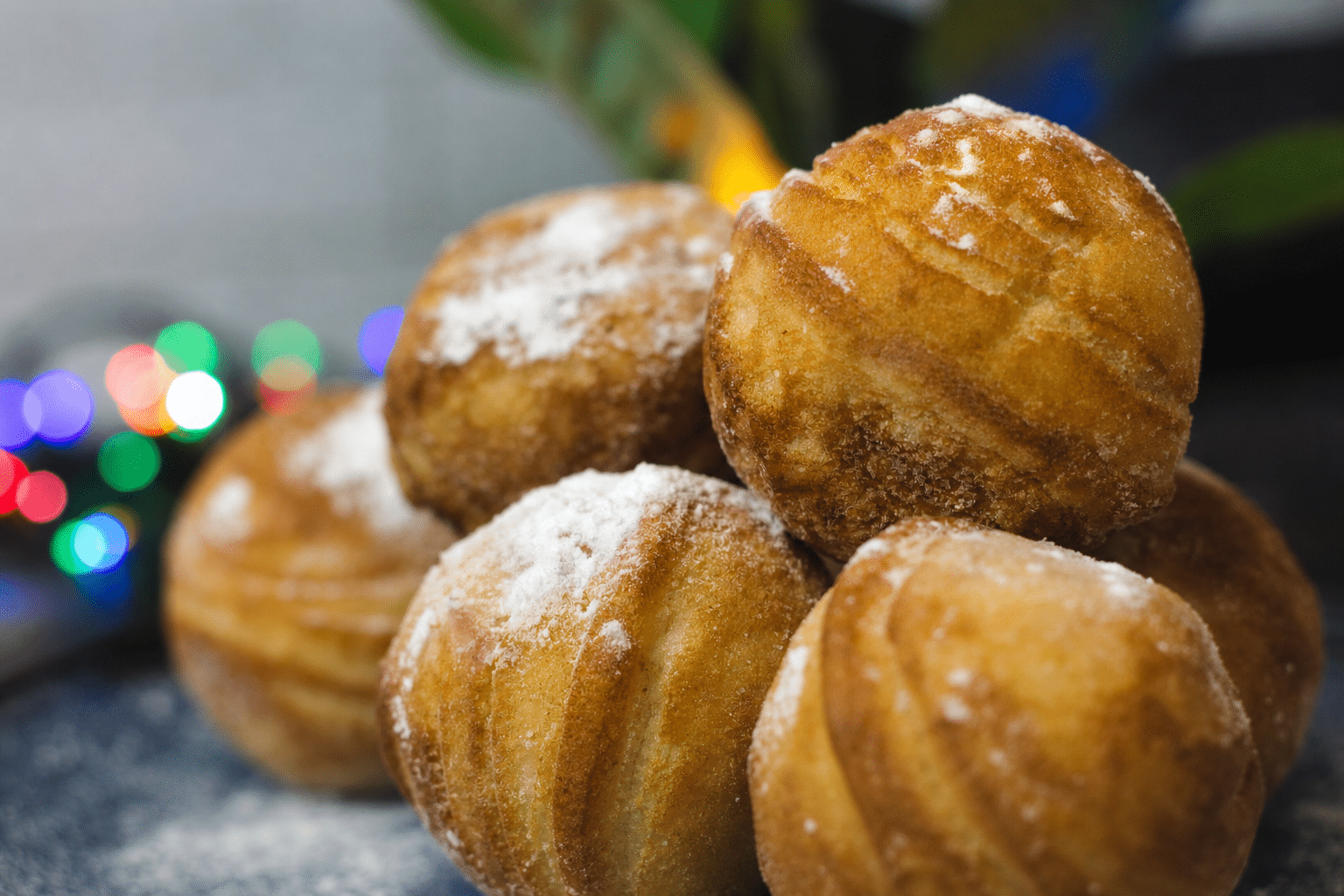

Æbleskiver (say it roughly “EB-leh-skee-ver”) are small, perfectly round pastries cooked in a special pan with rounded cavities – think Dutch poffertjes or pancake puffs, but bigger, more tender, and entirely their own thing. The name means “apple slices” in Danish, and that is exactly what they were: originally, apple slices were dipped in batter and fried. Sometime during the 1800s, Danish cooks started replacing the apple with sweet batter and shaping the whole thing into a sphere. The name stayed; the apples disappeared. The spherical version we know today began appearing in Danish cookbooks during that century, and it has barely changed since.
They are served warm, dusted with powdered sugar, and eaten alongside a spoonful of jam. In Denmark, no Christmas gathering is complete without a plate of them.
This version builds in lemon zest and cardamom, and uses folded egg whites for structure. That last step is what keeps these from collapsing the moment they leave the pan.
Why this recipe works
The two things that ruin most æbleskiver are a gummy center and a deflated, sunken shape. This recipe addresses both directly.
The egg whites are the main fix. I whip them separately to stiff peaks, fold in the sugar until the meringue is glossy, then incorporate it into the batter in two stages: a couple of tablespoons stirred in firmly to loosen the mixture, then the rest folded gently so the air stays in. That whipped meringue creates the internal structure that keeps each pastry puffed and light after cooking.
The cornstarch helps too. A small amount added to the flour lightly stiffens the batter, giving it enough body to hold its shape through the flipping and rotating that the cooking process requires.
For leavening, I use baking soda rather than baking powder. Baking soda works best in acidic batters, and buttermilk is exactly that. It reacts immediately and completely, giving more controlled lift.
The æbleskiver pan is not optional – it is what gives these pastries their shape. It is typically a heavy cast-iron pan with seven rounded cavities, and it is widely available online and at Scandinavian kitchen shops.
Ingredients
Makes 4 servings
For the batter:
- 3 eggs, separated
- Scant 1 cup (200 ml) buttermilk
- 1 cup (125 g) all-purpose flour
- 3 tablespoons (25 g) cornstarch
- 1/4 teaspoon (1 g) fine salt
- 1 teaspoon (3 g) ground cardamom
- 1 tablespoon (10 g) vanilla sugar (see Tips)
- 2 teaspoons (10 g) baking soda
- Zest of 1 unwaxed lemon
For the meringue:
- 2 1/2 tablespoons (30 g) granulated sugar
For cooking:
- About 3 1/2 tablespoons (50 g) palm oil or lard
To serve:
- Strawberry, raspberry, or blackcurrant jam
- Powdered sugar for dusting (optional)
Instructions
1. Separate the eggs. Put the yolks into a large mixing bowl and the whites into a clean, grease-free bowl.
2. Whisk the egg yolks together with the buttermilk until combined.
3. In a separate bowl, whisk together the flour, cornstarch, salt, cardamom, vanilla sugar, and baking soda. Finely grate the lemon zest directly into the dry mixture and stir to combine.
4. Add the flour mixture to the buttermilk-and-yolk mixture and whisk until smooth with no lumps.
5. Whip the egg whites to stiff peaks. With the mixer running, gradually add the sugar and continue whipping until the meringue is firm and glossy.
6. Stir about 2 tablespoons of the meringue into the batter to loosen it. Then gently fold in the remaining meringue, working carefully to preserve as much air as possible.
Read more: The creamy beef and leek pasta that tastes like it took all day but is ready in 30 minutes
7. Melt the palm oil or lard in a small saucepan over low heat.
8. Set the æbleskiver pan over medium heat and let it warm thoroughly. Add roughly 1 tablespoon of melted fat to each cavity.
9. Fill each cavity almost to the top with batter.
10. Watch for a crust to form around the edges while the center is still liquid. When that crust appears, use a toothpick or thin wooden skewer to rotate each æbleskiver about 90 degrees, letting the uncooked batter flow to the bottom.
11. Add another 1/2 to 1 tablespoon of batter into the opening of each one, then rotate them completely so the new batter seals the seam underneath.
12. Continue rotating gently until all sides are deep golden brown and the center is fully set.
13. Serve immediately, warm, with jam on the side and a dusting of powdered sugar.
Tips and variations
Vanilla sugar: Vanilla sugar is a standard Danish baking ingredient but less common in the US. Substitute 2 teaspoons (8 g) of plain granulated sugar plus 1/2 teaspoon vanilla extract stirred into the wet ingredients. Alternatively, vanilla sugar is easy to find at specialty food stores or online.
Fat choice: Lard gives a crispier surface and a richer, more pronounced flavor – the traditional choice. Palm oil is neutral if you want a cleaner result. Skip butter; its lower smoke point causes it to burn before the pan is hot enough to cook the pastries properly.
Flavor swaps: Leave out the cardamom and lemon for a plain, mild version. Swap in orange zest and a pinch of cinnamon for something more festive. For a savory take, omit the sugar and try confit duck as a filling.
Freezing and reheating: Æbleskiver freeze well. Let them cool completely, then freeze in a sealed bag. Reheat from frozen at 300°F (150°C) for 10 minutes.
Allergens: This recipe contains gluten (flour), eggs, and dairy (buttermilk). Those are the structural ingredients, so straightforward substitutions are limited – but a tested all-purpose gluten-free flour blend with xanthan gum can work if needed.