
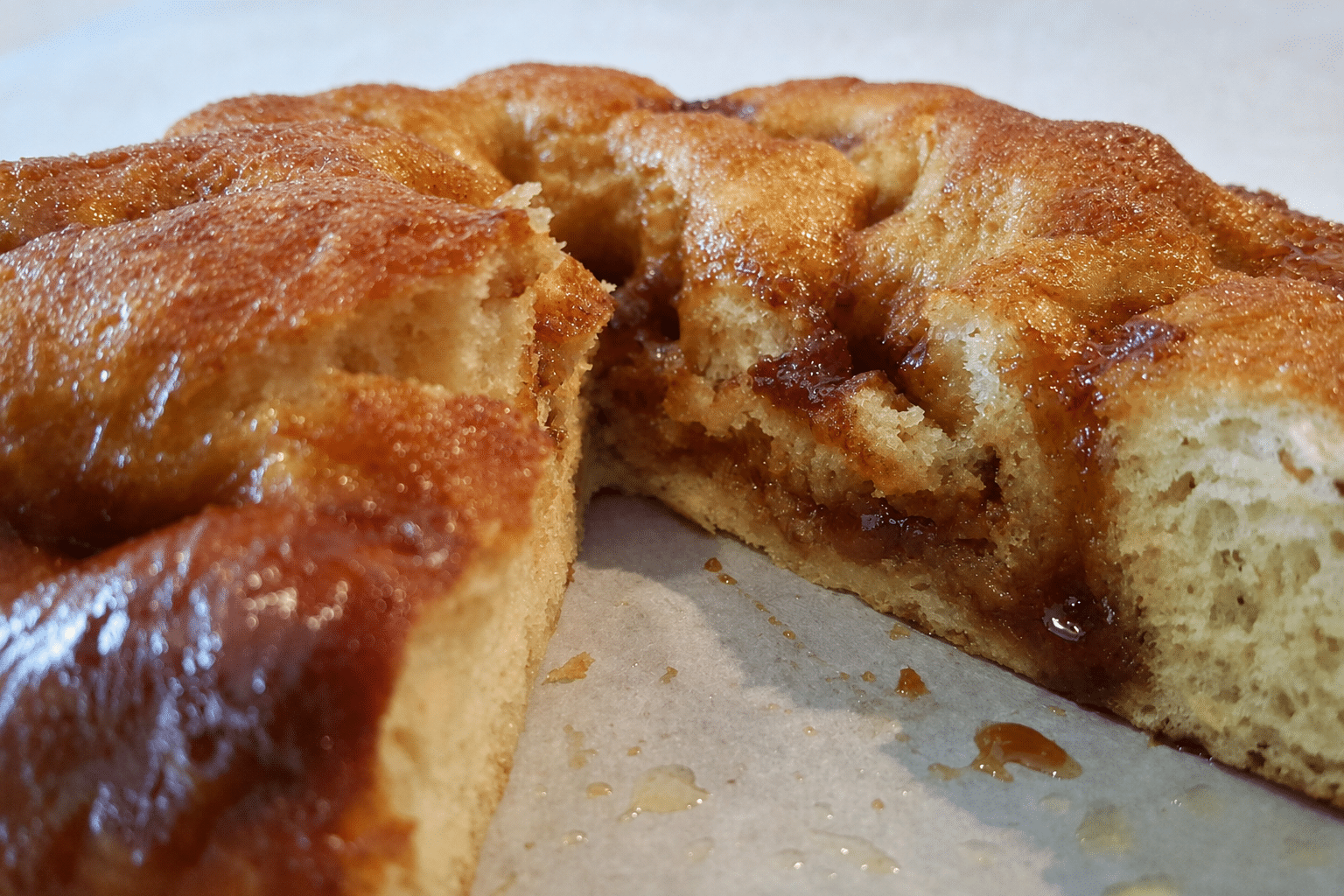

Brunsviger is Denmark’s great regional bake: a soft enriched yeast dough pressed into a round pan, dimpled all over with your fingers, then flooded with a mixture of melted butter and brown sugar (called remonce in Danish) so the caramel seeps into every pocket as it bakes. The result is a sticky, tender sheet cake that pulls apart in deeply caramelized hunks.
It tastes like the inside of a cinnamon roll poured over a coffee cake. It is almost unknown outside Scandinavia, it takes under an hour from start to finish, and this recipe from Anette Søstrøm Asmussen on gastrofun.dk is as classic as they come.
Why this recipe works
The finger holes are not decorative. Pressing them deep into the risen dough gives the butter-sugar filling somewhere to pool and seep. When the cake hits the oven, the remonce melts again, runs down into every channel, and gets baked into the dough rather than sitting on top.
Pouring the filling over the raw, risen dough (not a finished cake) is what creates the texture. The dough drinks up the caramel, the edges caramelize against the pan, and the whole thing comes out of the oven sticky and lacquered.
Ingredients
For the dough:
- 2 1/4 tsp active dry yeast (or 25 g fresh yeast)
- 1/2 cup (125 ml) whole milk
- 1 tablespoon + 1 teaspoon (15 g) granulated sugar
- 1/2 tsp (3 g) coarse salt
- 1 large egg
- 3 1/2 tablespoons (50 g) unsalted butter, softened
- 2 1/4 cups (275 g) all-purpose flour
For the remonce (butter-sugar filling):
- 2/3 cup (150 g) unsalted butter
- 2/3 cup packed (150 g) light brown sugar
Equipment: 9 1/2-inch (24 cm) springform pan or deep round cake pan, baking paper
Instructions
1. Warm the milk to 100°F (37°C), just barely warm to the touch. Add the yeast, stir, and let it sit for a few minutes until dissolved.
2. Add the sugar, salt, egg, and softened butter to the milk mixture. Add the flour and mix until you have a smooth, slightly sticky dough. No long kneading needed: just mix until it comes together uniformly.
3. Line the springform pan with baking paper. Press the dough evenly into the pan with your fingers so it covers the base in an even layer.
4. Cover with a clean kitchen towel and let rise at room temperature for 30 minutes. It will puff noticeably.
5. While the dough rises, melt the butter for the filling in a small saucepan over low heat. Add the brown sugar and stir continuously until the mixture is smooth and fully combined. Take it off the heat.
6. Preheat the oven to 400°F (200°C), conventional setting (not convection/fan).
Read more: Juicy pork chops in a creamy paprika sauce, all baked in one dish
7. Once the dough has risen, dampen your fingertips and press holes all over the surface, going deep enough to nearly reach the bottom of the pan. Space them so every part of the cake has a hole nearby.
8. Pour the butter-sugar filling over the dough, tilting the pan so it covers the whole surface and runs down into the holes.
9. Bake on the lowest oven rack for 20 to 25 minutes, until the edges are golden brown and the filling is bubbling and caramelized. The surface should look sticky and lacquered.
10. Remove from the oven and release the springform ring. Slide the cake onto a wire rack and cool for at least 10 minutes before slicing. The filling is molten straight out of the oven.
Read more: The Caesar salad that actually delivers, topped with crispy fried chicken
Tips and variations
Serve it warm. Brunsviger is best the day it is baked, when the caramel is still soft and the dough is springy. A slice alongside a strong cup of coffee is the classic way to eat it.
Fresh yeast vs. dry yeast. The original calls for 25 g of fresh yeast, which is standard in Danish home baking. If you can find fresh yeast at a health food store or specialty grocer, use it at that amount. Otherwise, 2 1/4 tsp of active dry yeast (one standard US packet) works well. Instant yeast also works at the same amount; skip the proofing step and mix it directly into the flour.
The filling looks like a lot. That is the point. Brunsviger is supposed to be sticky and saturated. Do not hold back on the remonce.
Watch the bottom. Because the cake bakes on the lowest rack, the base takes on color quickly. Around the 20-minute mark, lift an edge with a spatula to check that it is golden, not dark. Every oven runs a little differently.
Storage. The cake keeps at room temperature, loosely covered, for a day. After that, the caramel hardens and the dough dries out. It reheats well: 5 minutes in a 300°F (150°C) oven brings it back close to fresh.