
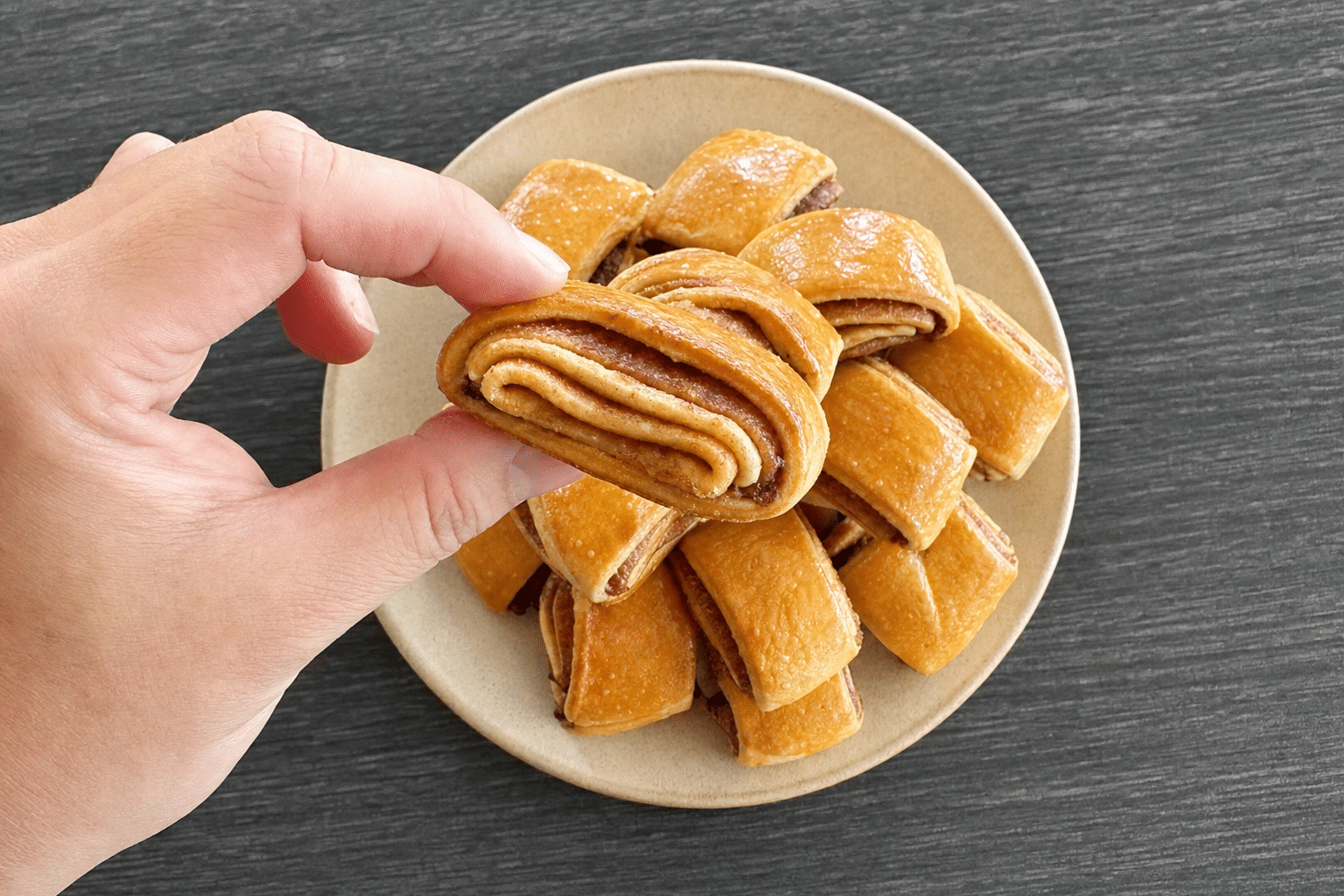

Kanelgifler are the cinnamon pastries you find at every Danish bakery, and they are genuinely different from what you get at an American mall. Where a classic cinnamon roll is simply rolled into a log and sliced, kanelgifler are folded – the filled dough is folded over itself two or three times before cutting, so each piece has distinct, buttery layers that pull apart as you eat them.
The filling is remonce, a staple of Scandinavian baking: soft butter, white sugar, brown sugar, cinnamon, and a tablespoon of flour. That flour is the trick. It keeps the filling thick and in place as it bakes rather than melting out and pooling on the pan. The result is a pastry with real structure – flaky on the outside, soft in the center, with cinnamon richness running through every layer.
This recipe makes 18 to 20 pieces. Perfect for a cozy weekend morning, and they will delight everyone who loves the sweet taste of cinnamon.
Why this recipe works
The fold is everything. Instead of rolling the dough into a log and slicing it crosswise (which gives you a simple spiral), you fold the filled dough on itself – bottom up, over again, one more time – before cutting. That technique builds multiple thin layers of dough and filling into each piece, giving a texture closer to a laminated pastry than a standard American roll.
The remonce filling is thicker than a simple butter-and-sugar spread, so it stays put during baking. Using both white and brown sugar gives a deeper, more caramel-like flavor than white sugar alone.
Ingredients
For the dough:
- 3½ tablespoons (50 g) unsalted butter
- Scant ½ cup (100 ml) whole milk
- 15 g fresh yeast, or 1½ teaspoons active dry yeast
- 1 tablespoon sugar
- About 2½ cups (300 g) all-purpose flour, plus extra for the work surface
- ½ teaspoon salt
- 1 large egg, plus 1 extra egg for brushing
For the remonce filling:
- 7 tablespoons (100 g) unsalted butter, at room temperature
- ¼ cup (50 g) white sugar
- ¼ cup (50 g) packed light brown sugar
- 1 tablespoon all-purpose flour
- 1 tablespoon ground cinnamon
Instructions
1. Start the dough. Melt the butter in a small pot, then pour it into a mixing bowl. Add the cold milk – the cold milk will bring the butter down to a lukewarm, finger-warm temperature. Crumble in the fresh yeast (or stir in the active dry yeast) and stir to dissolve. Add the sugar and the egg, and mix together.
2. Knead. Add most of the flour and all the salt, and knead on low speed. Add the remaining flour a little at a time and knead for 8-10 minutes until the dough is smooth and supple – it should be slightly tacky but not sticky.
3. First rise. Cover the bowl and set it somewhere warm for 45-50 minutes, until the dough has doubled in size.
4. Make the remonce. While the dough rises, mix the soft butter, both sugars, the flour, and the cinnamon together in a bowl until you have a uniform, spreadable paste.
5. Roll and fill. Lightly flour your work surface. Roll the dough out into a rectangle about 24 x 8 inches (60 x 20 cm), going quite thin. Spread the remonce evenly over the dough, leaving a ¾-inch (2 cm) strip uncovered along one long edge.
6. Fold. Starting from the long edge fully covered with filling (the opposite side from the uncovered strip), fold about 1½ to 2 inches (4-5 cm) of dough inward. Fold over again, then fold once more, so the unfilled strip ends up on the bottom. You should have a flat, compact log – like a thick, filled flatbread.
7. Cut and second rise. Cut the log crosswise into pieces about 1¼ inches (3 cm) thick. Place them seam-side down on a parchment-lined baking sheet, spaced a couple of inches apart. Cover loosely and let rise for 25-30 minutes.
8. Brush and bake. Beat the remaining egg and brush it over each piece. Bake in a preheated conventional oven at 400°F (200°C) for 12-13 minutes, until golden and baked through.
Tips and variations
Fresh yeast vs. active dry. Danish recipes call for fresh yeast, which is easy to find in Scandinavia but harder to track down in the US. Active dry yeast works well: use 1½ teaspoons in place of 15 g fresh yeast, stir it into the lukewarm butter-milk mixture, and let it sit a minute before continuing.
Roll the dough thin. The 24 x 8-inch rectangle is thinner than you might expect – this is what creates proper layers. If the dough is too thick, the fold will produce a bready result rather than a flaky one.
Don’t rush the second rise. The 25-30 minutes after cutting gives the swirls their light, open interior. Rush it and they will be noticeably denser.
Storage. Kanelgifler are best eaten the day they are baked. Store any leftovers in an airtight container and warm them for a few minutes in a 300°F (150°C) oven to bring them back.