

Domestic.Lab
It’s a cold Tuesday morning in March, with frost covering the rooftops. Normally, I’d step back into the hamster wheel once more, but today I veer away, sit behind the wheel, and head towards Aarhus. Today brings something entirely different, and though meeting new people doesn’t usually make me nervous, this is an exception.
I’ve ironed my GastroFun polo and given it an extra run with the lint roller because we’re meeting Morten Rastad, co-owner of the Michelin restaurant Domestic. In the car, we go over the last details—it’s important that we have a fun day and ask all the good questions!
We drive onto Marselis Boulevard, through the tunnel, and emerge into the last remnants of the industrial city of Aarhus. We have the address, yet we still manage to pass the anonymous building and only notice it because we happen to spot our lovely camerawoman, Henriette Toft, out of the corner of our eye.
But Domestic isn’t located at the harbor, you say. It’s in Mejlgade. Yes, it is, but we’re not going to Domestic…and yet, we kind of are. Morten Rastad has asked us to meet at Domestic.Lab, where he experiments with bacteria and fungi, creating things far more mouth-watering than one might initially imagine. We’ll get back to that.
We arrive in good time, so we sneak in through the door as a man leaves the building. It’s a bit too cold to stand outside and get blown through on such a biting cold morning at the end of winter. The building looks deserted. A closed reception, an empty staircase, and a wall filled with sad pigeonholes and worn-out Dymo labels. We stand there, soaking in the atmosphere—meanwhile, Henriette steps outside to capture the mood with her camera. A moment later, Morten arrives and leads us down a long, closed hallway and into the right. Into Domestic.Lab.
Domestic and the Dogmas
In the fall of 2015, Restaurant Domestic opened its doors for the first time. The two chefs, Morten Rastad and Christoffer Norton, met while working together at Molskroen and realized they shared the same dream of creating a restaurant experience without compromises for the guests but with a clear dogma in the kitchen: Only local ingredients.
As they put it, it must be ‘Local, sustainable, and cozy.’ A restaurant is much more than just a kitchen, so Ditte Susgaard and Christian Neve were the co-founders who would create balance from the service side and ensure a good and homely experience for guests at the restaurant.
If you know a bit about food and food production, you know that it’s not easy to manage solely with local ingredients and do without, for example, citrus fruits, coconut, soy, and chocolate. The list is long! Noma led the way several years ago, showing that it could be done. In 2017, Restaurant Domestic clearly demonstrated that it was also a task they could undertake. They were awarded their first Michelin star, and they still have it today.
The Stage is Set
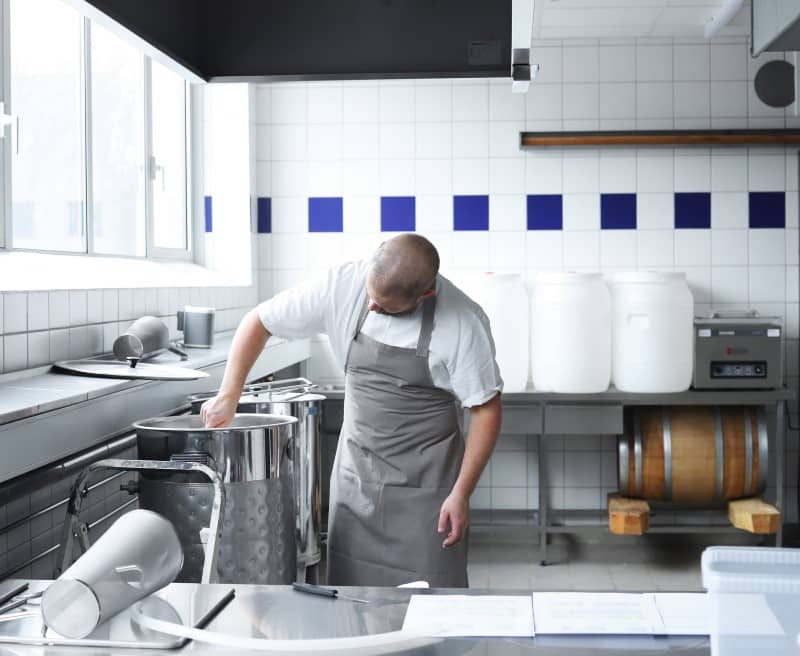
We have clearly stepped into a laboratory:
There are tiles from floor to ceiling, and almost everything else is made of steel. At the end of the room, there’s a table filled with glass jars, each with a piece of painter’s tape providing information about its contents.
On the floor, there are some steel tanks for beer brewing (also with painter’s tape) and a single oak barrel with an imperial stout underway, which goes by the working title Dark Vader. Michelin chefs have dad humor too!
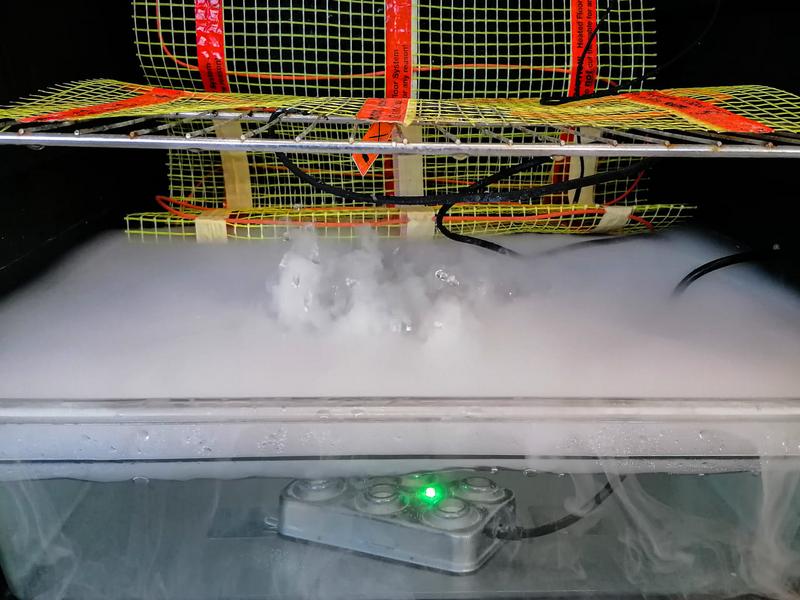
Just inside the door stands what used to be a wine cooler. Holes have been drilled in the side, and wires run through them. At the top, an oven grate is fastened with zip ties, and here the wires end at individual measuring devices. Temperature. Humidity. Data collection. The inside of the cabinet is covered with underfloor heating mats, and at the bottom of the cabinet under the grate is a tub of water with yet another device in it. Morten presses a button, and a white layer of smoke rolls over the tub, wraps around the edges, and waves out of the open fridge and down onto the tiled kitchen floor.
It’s the final touch. The icing on the cake in the laboratory.
Domestic.Lab
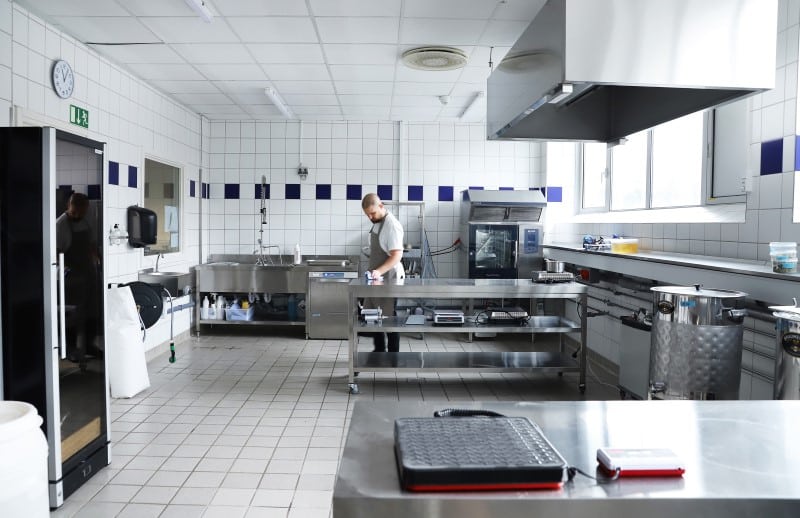
When only local Danish ingredients are allowed, a significant portion of the average Dane’s pantry is excluded. For example, I find it hard to imagine doing without ingredients like soy, pepper, and citrus fruits, just to name a few of the most used items in my own kitchen.
Necessity is the mother of invention, and a lot of experimentation is needed to compensate for all the foreign ingredients; and it’s a good thing that Christoffer and Morten have a handle on the craft. But one thing is skills, another is time and space.
As Morten explains, over time, they’ve had to realize that it’s not so easy to pickle, ferment, and experiment in the middle of service.
At first, it was easier, but as Domestic’s popularity grew, the number of covers more than doubled, changing the work pressure so much that they’ve drastically altered their setup.
Morten was previously the head chef at Domestic alongside Christoffer but has now changed his title to one of the more unusual: Fermentation Chief.
Morten has taken his new title and apron down to the harbor, where he and the rest of the team have set up a laboratory, Domestic.Lab. Here, there is time and space to experiment and produce various elements for the restaurant.
The mission is to come up with new taste experiences while staying true to the original concept: local ingredients, less food waste, less meat and dairy, and more vegetables. In the laboratory, Morten brews beer and develops kombucha and juice as alternatives to the wine menu.
Additionally, Domestic.Lab functions as a training and consulting company—in the process of writing, there’s a big project underway with Aarhus Municipality and Loop Food Lab!
Henriette has sorted out the lights and sound, the cameras are rolling, and we’ve made it through the first cup of coffee for the day. It’s time to get started…
Acidic and Salty
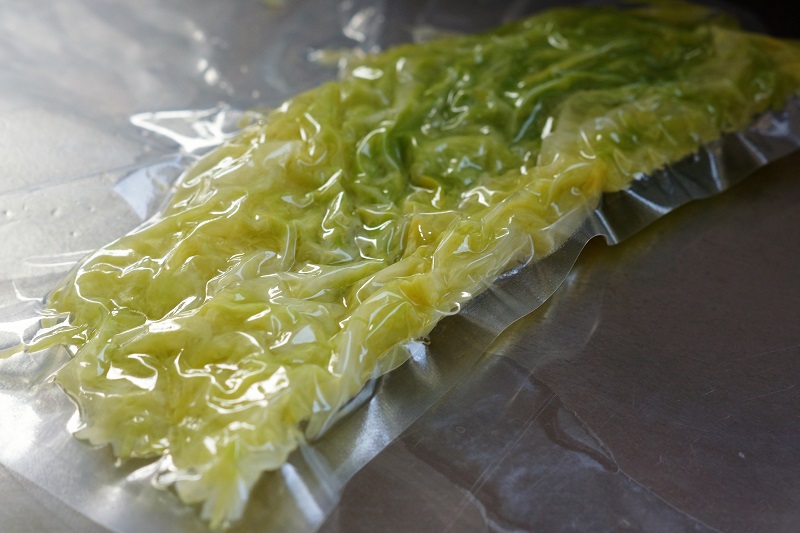
The first thing we’re making is sauerkraut. I expect we’ll try some different exciting versions of sauerkraut and kimchi—that we’ll visit both Germany and Korea—but Morten surprises me: “We always make a completely neutral sauerkraut, consisting of two things: cabbage and salt. Then we can always add flavors later when we come up with a good idea.”
I’m tasked with slicing the cabbage. Right now, it’s out of season, so we don’t get it from Domestic’s local supplier. Usually, it’s not actually Morten and Christoffer who decide the menu. It’s the suppliers who call the week before and tell us which ingredients are ready. Then it’s the chefs’ job to work magic with what they get.
The cabbage is sliced to the Michelin chef’s satisfaction (phew!) and is now placed on the scale. “Typically, you use up to 7-8% salt in a sauerkraut, but we aim for the lowest defensible amount of about 2% salt. If we go below 1.7%, there’s a risk of botulism/sausage poisoning, but if we go too high, we’ll kill many of the interesting microorganisms. We simply get the most interesting product when we salt as little as we do,” Morten explains.
198 g of cabbage times 2 divided by 100… we need 4 g of salt.
The salt is mixed with the cabbage and then placed in a vacuum bag and vacuum-sealed. “Now the cabbage is allowed to sit in the vacuum bag at room temperature for about a week, max 10 days. You can let it sit longer, but then it starts to taste a bit cheesy. The bacteria produce lactic acid and CO2, which are the most important processes to understand here. The CO2 causes the bag to puff up during the week. We cut a small hole at the top of the bag to let the air out and re-vacuum it, and then it’s ready to go in the fridge, where it can stay until we need it,” Morten explains and adds that it can, in theory, stay there indefinitely.
That’s how they do it at the restaurant, but if you don’t have a vacuum machine, you can also do it the old-fashioned way and put it in a canning jar with a clamp lid. Just remember to release the air occasionally so the jar doesn’t explode, Morten tells us. We fill a jar, and then it’s on to the kombucha.
Kombucha
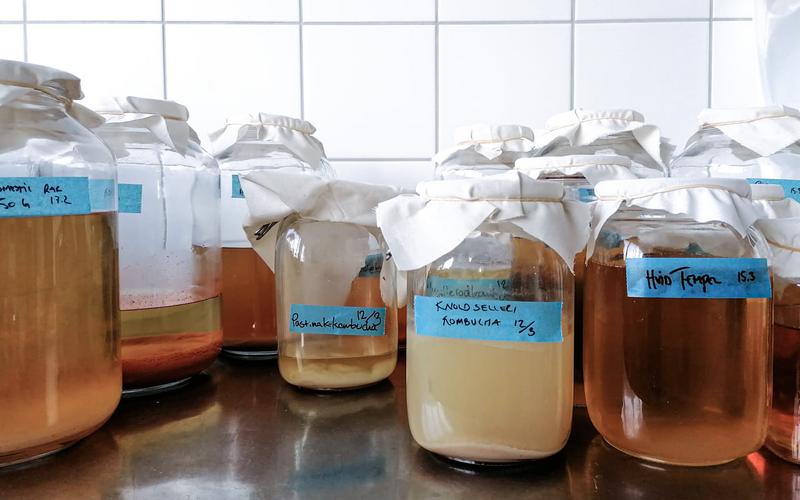
Morten opens a container, and the scent of quince tea fills the laboratory. We’re making kombucha, a fermented tea, by adding a culture of bacteria and fungi to a sweetened tea. The culture ferments the tea, resulting in a fresh and slightly sour drink. We start with boiling water. Sugar. Tea leaves.
Kombucha is typically made by adding a SCOBY, which is a mushroom containing a culture of bacteria and fungi, to a sweetened tea—here, the word ‘tea’ is used in the broad sense and does not necessarily contain tea leaves.
For a long time, it was believed that the mushroom itself was the culture, but according to Morten, it has turned out to be just the residual product. Therefore, it is the liquid in which the SCOBY lies that is the actual starter culture or base kombucha.
Domestic always must consider their dogmas. That’s why there are many different kombuchas in progress in the laboratory. Beetroot. Celeriac. Parsnip. Malt. The possibilities are endless.
Morten pours cold water into the glass and adds the hot tea, so we reach about room temperature and can add the ‘base kombucha’ with all the bacteria and fungi. If the temperature is too high, the culture dies! “It works best with white or green tea,” says the fermentation chief, “you can use black tea, but it’s processed much more and therefore contains far fewer bacteria, slowing the fermentation process.” Kombucha made with green or white tea takes about a week. With black tea, you should count on around 14 days.
The kombucha is ready, and Morten places a cheesecloth over the opening. On with an elastic band. Painter’s tape. Over to the collection.
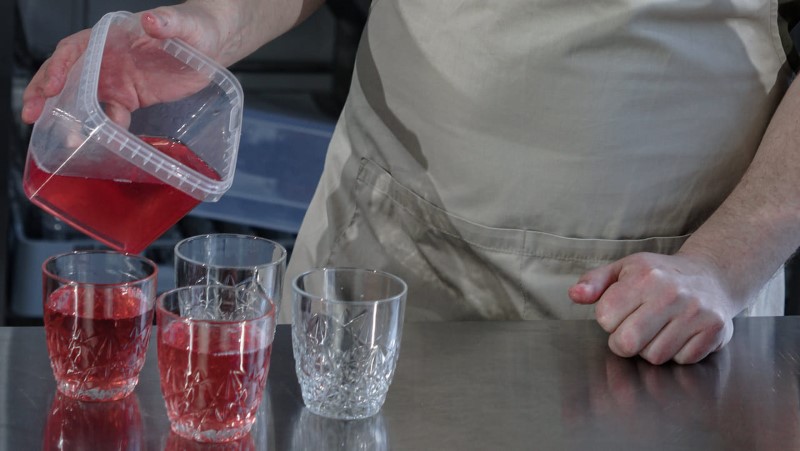
Morten finds four glasses and a bottle with a delicious, light red kombucha. He tells us it’s one they use in the restaurant. Grilled shiso leaves and rhubarb. It smells absolutely fantastic. I’m immediately transported back to childhood. It smells like summer, candy, red berries. “Without offending this really delicious kombucha,” I say, “it tastes and smells like a candy store. Especially those cherry gummies from Haribo.” Did I just say that?! “You’re right,” Morten thankfully says, “We live close to Carletti’s factory, and that’s exactly how it smells over there!”
Henriette peeks out from behind the camera, and Per rises from the director’s chair. For two minutes, we forget that the cameras are rolling. Damn, it tastes good!
And on to the miso.
Soybeans and Chocolate
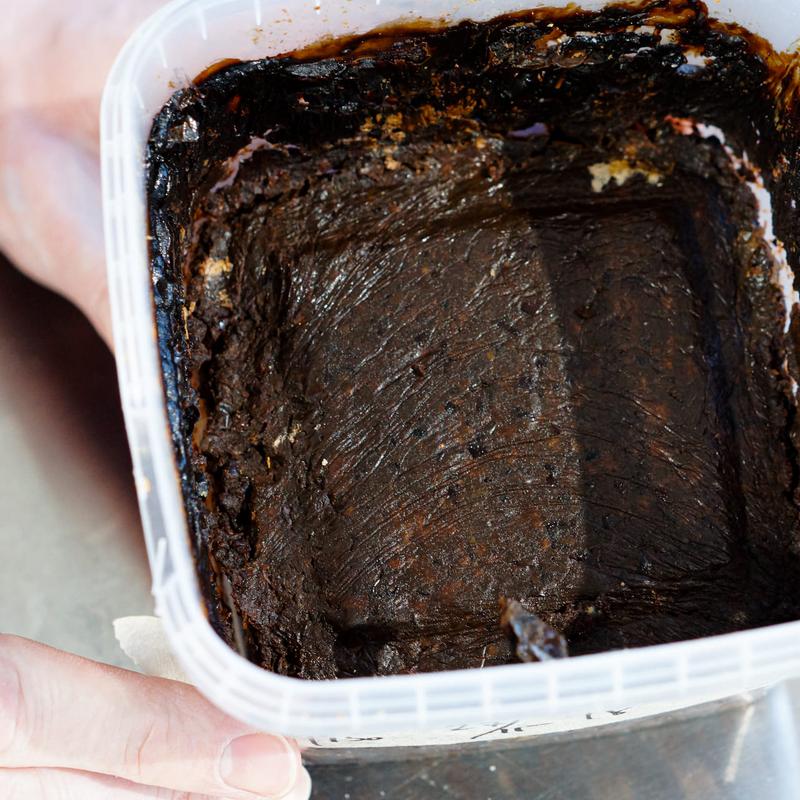
We’ve cleaned up after the kombucha, and the only thing on the table now is a container with moldy pearl barley, which Morten is eating from. Without saying anything. Normally, I’d be quite surprised, but I have such complete trust in Morten and his skills that I hardly think about it. I snag a few pieces myself. They smell and taste very distinctly of umami. “We first steam our pearl barley, then cool it down and add this white mold culture. Then we put them in the cabinet and set the humidity to 70% and the temperature to 25°C. And that’s how we get this product,” he explains, popping a few more pieces into his mouth. “We also make our own ‘chocolate’ in pretty much the same way. Here we just set the temperature to 37°C and roast the pearl barley in the oven afterward.” Morten goes over and digs into yet another container, returning with something that looks like cocoa nibs. Complex aromas burst forth. Malt. Licorice. Cocoa. We grab a few pieces. They are incredibly crispy and delicate, and they taste almost exactly as they smell: Fantastic! “We grind them in a mill and then use the powder for ice cream, ganache, and creams,” says Morten. But that’s not what we were supposed to be talking about. The miso awaits.
Miso is a fermented paste made from soybeans and rice or grains, which has been made in Asia for a couple of thousand years. At some point, it was discovered that the liquid that collected on top of the miso was quite tasty and that it was easier to flavor with due to its consistency. You could easily just use a few drops. That liquid is called tamari. Later, it was discovered how to make tamari without first having to make a miso—it became known as soy sauce.
In Denmark, we don’t grow either rice or soybeans, so the dogmas get in the way of miso and soy sauce. Therefore, Domestic uses yellow peas and fermented pearl barley instead. The yellow peas are steamed in the oven, and once cooled, they are mixed with the moldy pearl barley and run through a meat grinder. Then the mixture is combined with salt and poured into a container. A film is placed over the mixture, and on top, there’s another container filled with water to keep pressure on the mass. Morten explains that it’s important to have a bit of air for the miso, so it can release CO2 while fermenting and also capture some wild yeast from the air. Another important detail is that some esters, i.e., scent compounds, can develop a smell and taste of acetone if they can’t escape the miso.
The fermentation chief has found a miso. On the container’s painter’s tape, it says ’18. “We experiment quite a bit with the age of our miso, but we’ve never gone up to three years before, so this is the oldest miso we’ve made!” Morten lifts off the container with water, and the aroma immediately rises and tickles the nose. Figs, soy, and fresh nuts are the first and most prominent notes that hit me. Complex and deep notes in both aroma and taste. According to Morten, it can be used for all sorts of good things—seasoning soups and sauces, brushing vegetables, meat, and fish, and at home, he adds 1-2 teaspoons to the meat sauce before serving. I think they could do a bit of street sales on the miso. Especially the 3-year miso we just tasted!
Morten is a busy man, so we must wrap up after 3 educational hours in his laboratory. While Henriette and Per pack the last items into the bags, I take one last round in the laboratory, but then there’s no room for more impressions. We say thank you for today, head to the office, and hope Morten has time again another day!
The Fermentation Chef
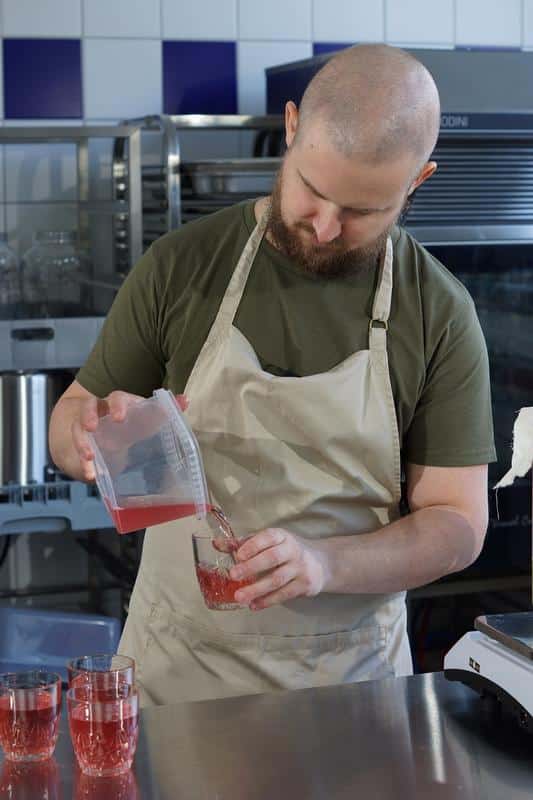
- Morten Pfeiffer Rastad was born in 1987
- Former co-owner of Restaurant Domestic* and the associated Domestic.Lab
- Since 2022 he has been working on his own company NOCLA where he is the Head Of Fermentation.
- Originally dreamed of becoming a chef but put it aside and instead chose engineering studies in Aarhus.
- Ended up dropping out of the engineering program after two semesters to pursue a career as a chef with a clear goal that it would become something big.
- Has worked at, among others, Ruths Hotel, Fru Larsen, and Molskroen, where he met Christoffer Norton.