

When cooking with conventional methods on a pan, in the oven, or on the grill, the cooking time is the crucial factor one has to decide upon. We all know rules of thumb like ‘roast the culotte 30 minutes per kilo’. While such rules aren’t foolproof, they feel right because many used them as we grew up. Sous vide is relatively new, and it doesn’t offer the same opportunity to use instinct. With traditional cooking, it’s easier to see or feel if the food is as you think it should be.
When cooking with sous vide, it’s not just about time but also temperature. This allows for much higher precision in cooking, but it also means higher expectations. Because you have to consider two factors (time and temperature), it takes longer to become proficient. In this article, I will explain how you can confidently choose the right time and temperature when cooking meat sous vide. Hopefully, you’ll learn it faster.
To determine time and temperature, consider the following:
- Is the cut tender (fine fibers, little connective tissue) or tough (coarse fibers, a lot of connective tissue)? A tough cut requires more time and/or higher temperature to become tender
- How tender do you want it? More time in the water bath makes the meat more tender. If it stays too long, it becomes mushy!
- How thick is it (and what shape does it have)? The time it takes for the core of the meat to reach the desired temperature in a sous vide depends on thickness, not weight. If it’s twice as thick, it takes four times as long to heat through
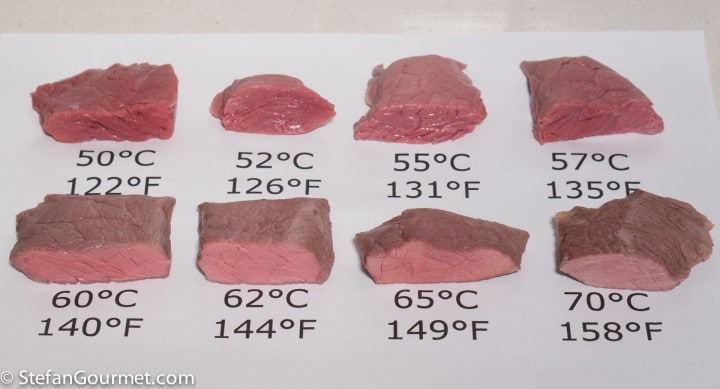
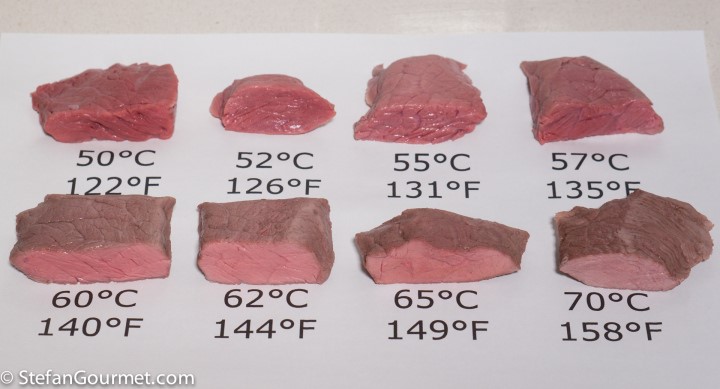
- How red should it be? It’s solely about temperature: 55C is ‘medium rare’ (red), 60C is ‘medium’ (pink), 65C is ‘medium well’ (slightly pink), and 70C and above is well-done. Once the meat reaches a certain temperature, continuing to cook at a lower temperature doesn’t work. Just like a hard-boiled egg, you can’t turn it back into a soft-boiled one afterwards
- Does it need to be pasteurized? Poultry, minced meat, and game do. For beef, lamb, and pork, it’s only necessary when serving to people with weakened immune systems (e.g., elderly or pregnant). To pasteurize, you must add extra cooking time. How much time depends on the temperature. You can pasteurize from 52C, but at such a low temperature, the cooking time will reach up to 5 hours. Click here for more information on food safety (English)
- Is the meat fresh or frozen? If it’s frozen, you can cook it directly from the freezer. It will actually be faster than thawing it first (30 minutes for 2.5 cm thickness, 2 hours for 5 cm thickness)
The guidelines below take all these factors into account.
See our guides to choosing the right sous vide wand or sous vide machine
Tender Beef, Lamb, or Pork: Only Heating Through
This includes all whole cuts from farmed animals except poultry. For example:
- Beef: Tenderloin, ribeye steak, strip steak (sirloin), rump steak
- Lamb: Lamb chops, rack of lamb, lamb leg
- Pork: Tenderloin, pork loin
Since this is tender meat and doesn’t need pasteurization, it only needs to stay in the sous vide until the desired core temperature is reached (you should sear the surface either before or after the sous vide to kill the surface bacteria on the meat). This means that temperature is set according to the desired degree of doneness, and time is set according to thickness and shape. It also means it doesn’t make sense to cook it and then chill or freeze it, as reheating and cooking amount to the same.
Use a chart, like the one below, to choose the right temperature:
Regarding time, it’s important to understand that when you put cold meat into the warm water of the sous vide, it takes time for the heat to penetrate the meat. How long it takes depends on the meat’s thickness and shape.
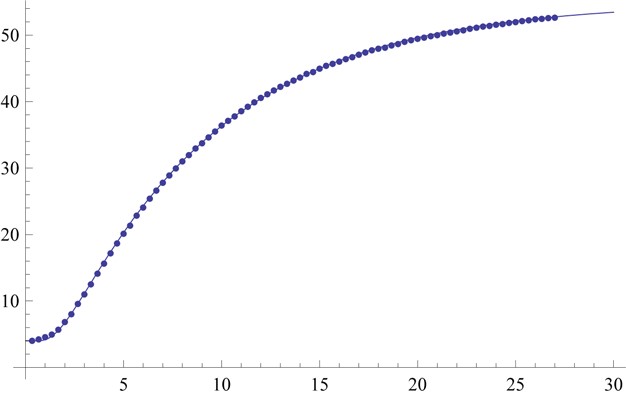
The graph above shows how a piece of meat’s core temperature rises in a sous vide at 55C (time on the x-axis and temperature on the y-axis). As you can see, the temperature rises quickly at the start, as the difference between the cold meat and the warm water is greater, and thus, the heat diffusion is stronger. When the core temperature approaches the water’s temperature, it rises only slowly. The graph shows the temperature is at 52C after just 30 minutes, but it takes more than an hour to reach above 54C. This is important to remember when reheating food in the sous vide, as it doesn’t matter if you don’t heat it all the way through. Another important thing to remember is that the heating time is a quadratic function of thickness. This means when the meat is twice as thick, it takes four times as long to heat through. For example, a slice/steak of 2.5 cm will take 35 minutes to heat through, while a slice/steak of 5 cm will take 2 hours and 20 minutes.
The mathematical calculations required to determine the time it takes for the food’s core temperature to reach the water’s temperature are quite complicated. Therefore, it’s best to use a chart for this purpose, like the one below.

I have adapted the chart from the large table in Modernist Cuisine. The time depends on thickness and shape: slice (like a steak), cylinder (like a sausage), or sphere (like a ball or cube). The times in the chart are for refrigerated meat. Frozen meat takes longer. Note that the times here are shorter than those found from other sources. This is because Modernist Cuisine has calculated the time it takes to reach a temperature 1C below the water’s instead of 0.5C, as many others reckon. Additionally, I calculate from refrigerator temperature to 60C instead of 80C. Overall, it makes quite a difference.
If you leave the meat in the water for less time than the chart indicates, the meat will reach a temperature lower than 1C below the water’s, and the meat won’t be as cooked as you would like. If you let it lie longer, the meat will gradually become more tender. The meat becomes tender faster at 60C than at 55C. You can usually leave it for several hours before it becomes too tender (read: mushy!). For the very tender cuts like tenderloin, it doesn’t do any good, but I like to give my rack of lamb or ribeye a few extra hours to make it more tender.
Tender Poultry, Game, or Minced Meat: Pasteurize
If there is a risk that the meat may contain harmful bacteria, you must pasteurize it. This means that after the meat is heated through, it must remain in the water for a while for pasteurization to occur. This risk is generally present with poultry, game, and minced meat. The most common examples of poultry are chicken breast, turkey breast, and duck breast. I prefer 60C for chicken breast, 56C for turkey breast, and 55C for duck breast. I like to give duck breast a little longer than necessary to pasteurize, so it becomes a bit more tender. You can cook burger patties sous vide so they are red inside and still pasteurize them so you can eat them safely. Burger patties are fantastic in sous vide at 55C and then a turn on a blazing hot grill at the end. For game, the temperature should ideally be between 53C and 55C. This can be venison loin, pigeon breast, pheasant breast, or partridge breast.
To find the total cooking time, you need to add the pasteurization time and heating through time from the table above (this is a somewhat conservative approach, as pasteurization begins as soon as some of the meat reaches 52C). Since the heating through time is to 1C below the water’s temperature, aim for a pasteurization time that is 1C below the water’s temperature.

Here are a few popular examples:
- Turkey breast 5cm thick, cooked at 56C for 3hrs 51mins (2hrs 20mins heating through + 1hr 31mins to pasteurize)
- Chicken breast 2.5cm thick, cooked at 60C for 53mins (35mins to heat through + 18mins to pasteurize)
- Chicken breast roulade with a diameter of 7.5cm, cooked at 60C for 3hrs 8mins (2hrs 50mins to heat through + 18mins to pasteurize)
- Duck breast 2.5cm thick, cooked at 55C for 2hrs 52mins (35mins to heat through + 2hrs 17mins to pasteurize)
- Pigeon breast 1cm thick, cooked at 55C for 2hrs 23mins (6mins heating through + 2hrs 17mins to pasteurize)
- Burger patty 1.5cm thick, cooked at 55C for 2hrs 30mins (13mins to heat through + 2hrs 17mins to pasteurize)
- Venison steak 1cm thick, cooked at 53C for 5hrs 49mins (35mins heating through + 5hrs 14mins to pasteurize)
As mentioned, you can easily leave the meat in the sous vide for a few hours longer than indicated. It takes many extra hours before the meat becomes too tender.
See Sous vide recipes here: Beef Culotte, Bone-in Chops ; Pork Cheeks ; Beef Cuvette ; Creme Brulee ; Duck Breast ; Roast Beef
Tough Cuts: Both Medium Rare and Tender or Medium and Tender
Tough cuts have a lot of connective tissue and are typically used for stews and braising. With sous vide, you can choose whether you want to transform tough meat into a tender steak or give it the texture of a stew, braise, or pulled, like pulled pork (see next section).
Cooking these cuts so they become tender but still red or pink is something only possible with sous vide. The advantage is that it becomes more flavorful and at the same time cheaper than buying tender meat. It may take a long time in the sous vide, but since it doesn’t require attention while it’s there, it’s not a problem. It just requires a bit of planning, and you can cook it in advance, chill or freeze it, and then reheat it when you need it (for reheating time see instructions for tender meat).
The temperature required to achieve this is between 55C and 62C, depending on the type of meat. The time is anywhere from 8 hours to 4 days, again depending on the type of meat. Here are a few examples:
- Beef: oxtail (4 days at 60C), flank steak or skirt steak (24-48hrs at 55C), flat iron steak or blade steak (12hrs at 55C), chuck (3 days at 55C or 62C if it should fall apart a little), short ribs (2 days at 57C), brisket (2 days at 57C)
- Veal: osso buco/shank (3 days at 62C to make it flake/fall apart a little)
- Lamb: shoulder, neck or breast (24hrs at 57C), shank (2 days at 62C)
- Pork: shoulder, neck, ham or shank (2 days at 57C)
- Wild boar: shoulder or neck (2 days at 57C), cheeks (2 days at 62C)
- Game meat: shoulder (8hrs at 55C), shank (2 days at 62C)
- Duck legs (24hrs at 64C)
When the cooking time is this long, the meat always gets pasteurized. The cooking times are not so precise – a few hours more or less doesn’t make much difference. It also means that size/thickness doesn’t matter much (unless it’s a huge roast requiring a long time to heat through).
Tough Cuts that Can Be Pulled
You can also cook tough cuts so they become flaky and can be pulled (like pulled pork). The texture is like when making stews or braising, but with sous vide, it’s easier to achieve the same result every time and even juicier. My favorite temperature here is 74C, and it works with many different kinds of meat. The meat requires 18 to 24 hours before you can pull it. The method is good for:
- Beef: neck, short ribs, flank steak, skirt steak, brisket
- Pork: shoulder, neck, cheeks
- Lamb: shoulder, neck, breast
- Game: shoulder, neck
- Wild boar: shoulder, neck, cheeks
You can raise the temperature to shorten the time and make the meat even flakier, but it’s at the expense of juiciness. Beef chuck can thus be cooked in 5 hours at 88C, but I prefer 24 hours at 74C. The only exception is confit duck, which I prefer to cook for 8 hours at 82C to achieve the traditional texture. To compensate for the lack of juice, I add melted duck fat to the meat.
When the cooking time is this long, the meat always gets pasteurized. The cooking times are not so precise – a few hours more or less doesn’t make much difference. It also means that size/thickness doesn’t matter much.
Troubleshooting
If you cook some meat in your sous vide that you’re not satisfied with, here’s how you can adjust the cooking time and temperature the next time you cook the same type of meat.
- Check the chart one more time, to see if the cooking time and thickness of the meat match. Otherwise, you may come to the wrong conclusion
- If the meat is too tough, extend the time next time
- If the meat is too soft or mushy, shorten the time next time
- If the meat is undercooked (too red), raise the temperature next time
- If the meat is overcooked (gray), lower the temperature next time
I recommend only adjusting either time or temperature, not both. Otherwise, you won’t know which one made the difference.
We have asked the skilled Dutch blogger Stefan to write this fantastic post about cooking meat sous vide.
Thanks to the author Stefan for this amazing blog post. You can read the original post in English here.