



Recipe for pizza margherita in pizza oven
Pizza Margherita, an iconic dish with deep roots in Naples, Italy, is not just a simple slice of dough and topping. This simple yet irresistible pizza has a rich history and a flavor that has conquered palates worldwide. The name “Margherita” carries a significant anecdote that reflects its Italian heritage.
The story of Pizza Margherita’s name dates back to the late 19th century, when Italian King Umberto I and Queen Margherita visited Naples. The Queen was curious to taste the local pizza, and the pizzaiolo Raffaele Esposito was invited to the royal palace to prepare a variety of pizzas. It is said that Raffaele Esposito created three different pizzas to honor the Italian flag with its red, white, and green colors. The pizza that impressed the Queen the most was a simple combination of tomatoes, mozzarella, and basil, which represented the Italian national colors. Queen Margherita was so delighted with this flavor experience that she gave the pizza her name, thus “Pizza Margherita” was born.
This pizza has since become a symbol of simplicity and authentic Italian flavor. With just a few, but top-quality ingredients – fresh tomatoes, mozzarella cheese, and basil – Pizza Margherita exemplifies how minimalism can create the most exquisite taste experience. And here comes the very hot oven into the picture.
Baking a Pizza Margherita in an oven that reaches temperatures close to 500 degrees Celsius is crucial for achieving the perfect balance between a crispy crust and juicy toppings. The intense heat gives the dough a quick and even rise, resulting in a light and airy crust that is a delight to bite into. At the same time, the high temperature allows the mozzarella cheese to melt quickly and evenly, becoming creamy and lightly golden without excessively drying out or burning.
So when you prepare your own Pizza Margherita at home, it’s essential to mimic the hot oven from Naples by preheating your oven to the highest temperature it can reach, as well as possibly using a baking steel. This will help capture the authentic flavor and texture that have made Pizza Margherita an indispensable part of Italian culinary heritage.
Why should you bake pizza at very high temperatures?
Baking dough at different temperatures affects the chemical and physical processes that occur within the dough. When you bake dough at 500 degrees instead of 250 degrees, several crucial changes occur:
- Faster rise: The higher temperature will result in a more dramatic increase in the dough’s volume. The yeast in the dough reacts more quickly at higher temperatures, leading to a more explosive rise. This results in a light and airy interior texture of the dough.
- Crispier crust: The high temperature provides a quicker and more intense crust formation. The outer surface of the dough dries out faster and forms a thin, crunchy crust. This creates the characteristic crispiness and bite desired in many pizza doughs.
- Caramelization of sugars and proteins: At higher temperatures, sugars and proteins in the dough begin to caramelize more quickly. This creates a golden-brown color and a richer flavor in the crust. It’s a crucial part of developing the characteristic taste of good baked products.
- Shorter baking time: The higher temperature will significantly reduce the overall baking time. This means the dough doesn’t have as much time to develop a deep flavor and complexity as it would with longer, slower baking at lower temperatures. On the other hand, the dough’s moisture is better preserved at the higher temperature, contributing to its light consistency.
- Less even baking process: While the higher temperature provides a quicker and more dramatic effect on the dough, it can also lead to a less even baking process. It’s important to monitor the dough closely to avoid burning or overbaking due to the intense heat.
In summary, a baking process at 500 degrees affects the dough by creating a faster rise, a crispier crust, and more intense caramelization of the surface. It results in a characteristic texture and flavor that are typical of pizzas baked at very high temperatures, like in a traditional stone oven.
I used a gas pizza oven for this recipe. Here, the temperature was approximately 500 degrees on one side and 400 degrees on the other side.
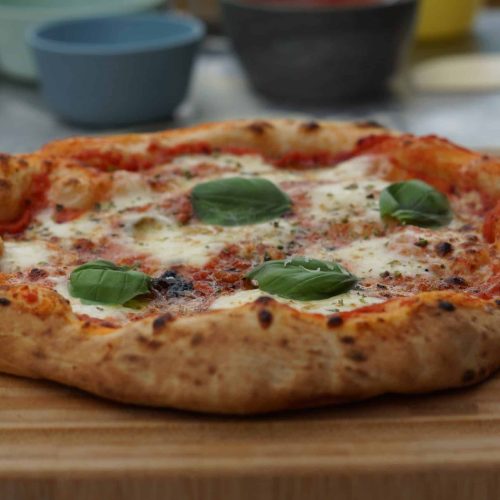
Pizza Margherita in pizza oven
Equipment
- 1 Immersion Hand Blender for the sauce
- 1 Pizza Oven or baking steel for conventional oven
Ingredients
Dough
- 525 gram Water cold
- 750 gram Wheat Flour e.g., Caputo
- 3 gram Dry Yeast
- 18 gram Salt
Pizza Sauce
- 400 gram Tomato crushed, e.g., Polpa
- 1 clove Garlic
- 5 gram Onion Powder
- 10 gram Sugar
- 5 gram Salt
- 1 pcs. Plum can be omitted
- 20 gram Olive Oil
- Oregano
- Salt and Pepper
Topping
- Buffalo Mozzarella not shredded, but in smaller pieces
- Parmesan freshly grated
- Basil
- Olive Oil
- Sea Salt
- Salsiccia Sausage can be omitted
Instructions
Dough
- In a large bowl, combine cold water, wheat flour, and dry yeast. Mix the ingredients together until the dough begins to come together.
- Add salt and knead the dough thoroughly until it is smooth and elastic.
- Cover the dough with plastic wrap or a clean cloth and let it rise at room temperature for at least 8 hours or overnight.
Pizza sauce
- In a bowl, blend the crushed tomatoes together with garlic, onion powder, sugar, salt, and olive oil using an immersion blender.
- If desired, add an egg yolk and blend again.
- Season with oregano, salt, and pepper to achieve the desired taste.
- Now you have a delicious pizza sauce, ready to be spread on your pizza bases and topped with your favorite ingredients. Bon appétit!
Pizza
- Preheat your pizza oven according to the manufacturer's instructions. Typically, the oven needs to be preheated for about 15-20 minutes to reach the correct temperature.
- Divide the dough into the desired number of portions (usually one portion per pizza) and shape each portion into balls of at least 250 g.
- Let the balls rest and rise for about 15-20 minutes under a cloth.
- When the oven is sufficiently preheated, gently stretch each dough ball into a thin pizza base by pressing the dough flat with your fingers and working from the center out to the edges.
- Place the stretched dough on a pizza peel or a lightly floured surface.
- Spread an even layer of the previously prepared pizza sauce over the stretched dough.
- Sprinkle grated Parmesan cheese over the sauce.
- Distribute fresh mozzarella cheese in smaller pieces evenly over the Parmesan and sauce.
- If using salsiccia, remove the sausage meat from the casing and crumble it over the pizza.
- Drizzle a little olive oil over the pizza and sprinkle with a pinch of sea salt.
- Carefully slide the pizza from the peel into the hot pizza oven and bake for about 2-3 minutes or until the crust is golden brown and the cheese is melted and bubbling.
- Use a pizza peel to remove the pizza from the oven and place it on a baking sheet or cutting surface.
- Once the pizza is out of the oven, add fresh basil leaves and extra olive oil on top.
- Cut the pizza into slices and serve immediately.