
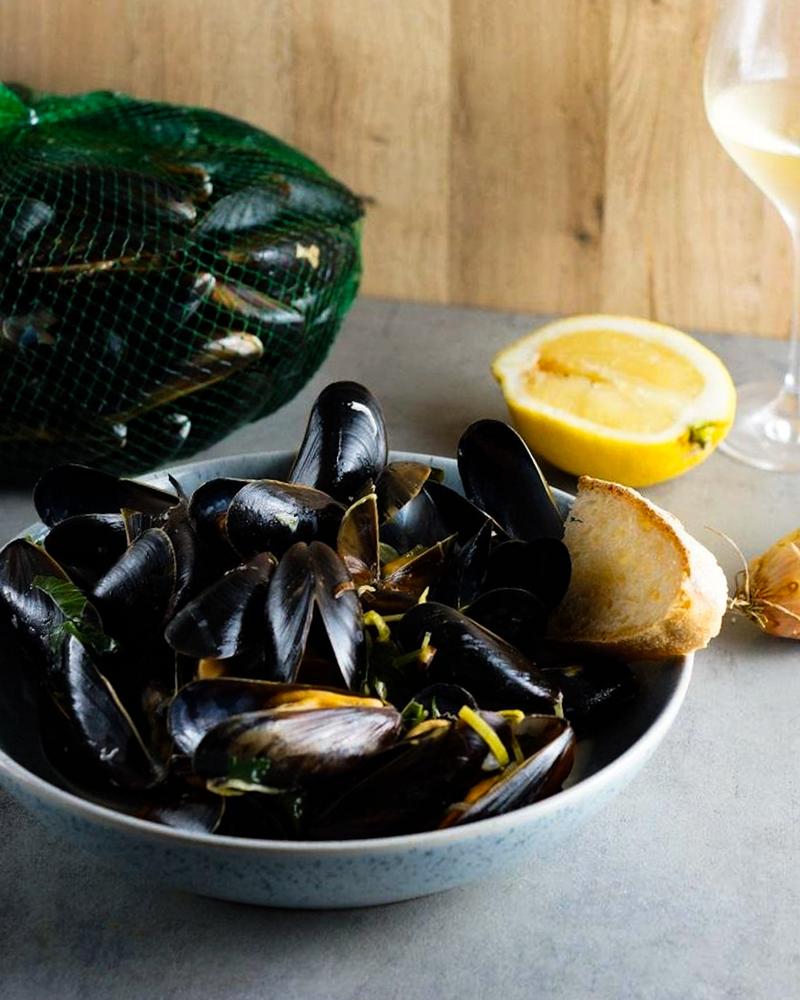

Moules marinières. These white wine steamed mussels are probably the most classic way to prepare them.

Recipe for moules marinières (white wine steamed mussels)
Moules marinières. These white wine-steamed mussels are probably the most classic way to prepare them.
Whether the dish was invented in Belgium or France is a matter of debate. It doesn’t make much difference, but it is a sure hit at a bistro in both countries.
In my work with GastroFun PREMIUM, I am fortunate to meet many talented food professionals. Here, we have had a visit from Mikkel Wejdemann (Madmikkel), who is an expert in oysters and mussels.

Servings: people
Moules marinières (white wine steamed mussels)
Moules marinières. These white wine steamed mussels are probably the most classic way to prepare them.
Equipment
- Sieve
- Cutting Board
- Knife
- Pot
Ingredients
- 750 gram Blue Mussels
- 0.5 pcs. Leek
- 2 pcs. Shallots
- 2 cloves Garlic
- 0.5 bunch Broad leaf parsley
- Oil For frying
- 150 gram White Wine
- Salt and Pepper
- Lemon Juice
Instructions
Preparation of mussels
- Remember to start thinking about the fact that we have one of the best food safety regulations here in Denmark, so you can be sure there are no bacteria in the mussels.
- Although it is a safe food, there are still some things you need to be aware of before eating these delicious mussels, especially if you choose to pick them at the beach yourself. Ensure there is no industrial discharge nearby and that you collect them in months that have an "r" in them. That means not in May, June, July, and August.
- If there are any growths/algae on the shell, it's not a big deal. You can remove them, but they can stay. It's mostly for aesthetic reasons that you should remove them, and you can do it with a knife.
- The next step is to ensure that your mussels are alive. Even if you bought them in a vacuum pack in the supermarket, they are still alive and should be when cooked. If they are not alive, you could get sick from eating them. Mussels generally close to protect themselves from predators, so you need to ensure they can close. You do this by tapping the open ones a few times on the table. They will slowly close (remember, they are not fast). Discard those that do not close. Some mussels have a "beard" that you can scrape off with a knife. Discard those with a hole in or damaged shell. When in doubt, you can always go by 'better safe than sorry,' but remember to discard any mussels that do not open after cooking.
- Pour all the mussels into a colander and rinse them under cold water from the tap.
Moules marinières
- Cut the leek into thin slices and chop the onion and garlic.
- Roughly chop the parsley.
- Turn on a large pot to the highest possible heat and add a little oil.
- Add the leek, onion, and garlic to the pot and fry them for 1-2 minutes until they get a bit of color.
- Add the mussels to the pot and put the lid on.
- Hold the lid and shake the pot a few times if necessary.
- Steam them for 2 minutes.
- Remove the lid and add the white wine and parsley.
- Put the lid on again and give the pot a few shakes to distribute everything.
- Now, let them steam for 4 minutes.
- Add the cream and cook for 1 more minute.
- Season to taste with salt, pepper, and lemon juice if needed.