
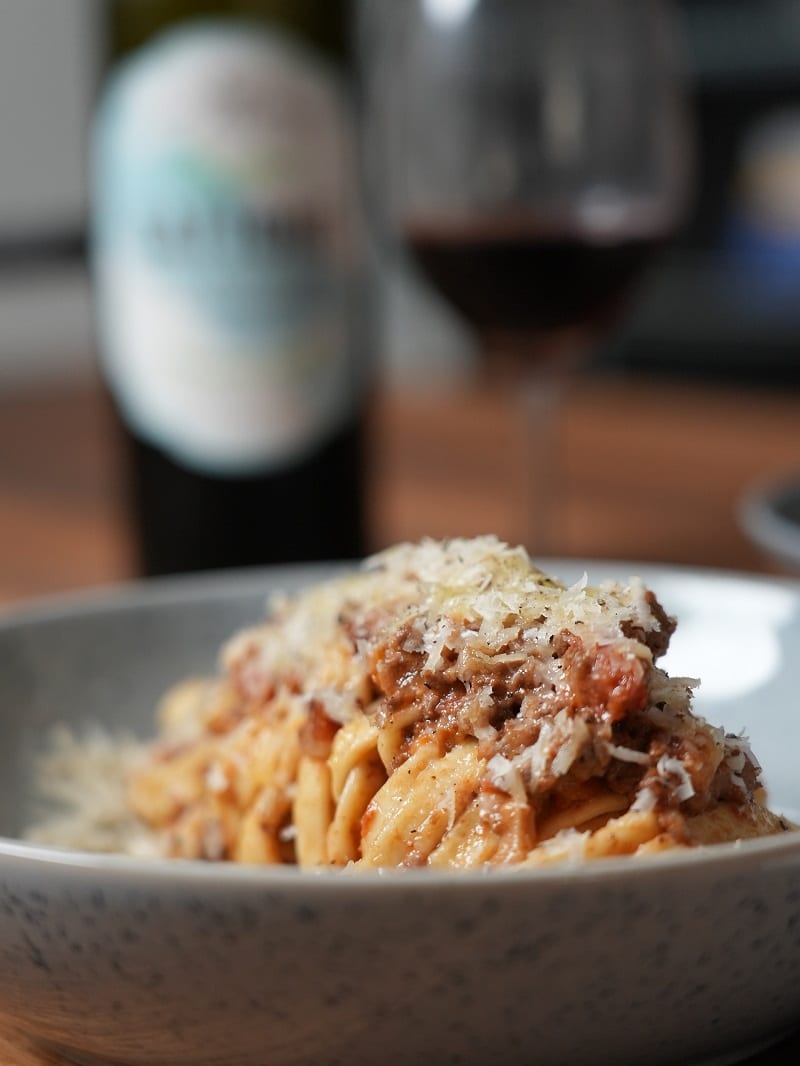


Recipe for pasta bolognese – the original recipe
Pasta with meat sauce is one of the cornerstones of the Danish everyday kitchen. I don’t think I know anyone who doesn’t eat it, or at least ate it a lot during their childhood. However, occasionally the Danish meat sauce is mistakenly called bolognese. And that mistake needs to be corrected!
First of all: Yes, there are many ways to make a bolognese, and in Italy, the exact recipe varies from village to village and from one street to the next. But there are still some basic things that are common to most of the recipes. And you don’t have to make a bolognese – you can make a meat sauce exactly as you like.
But now, let’s delve a bit into the history and understand where the famous bolognese comes from and what, at least officially, defines this popular dish.
The correct name for the dish is RAGÚ BOLOGNESE, and bolognese means it is from Bologna, which is the capital of the northern Italian region of Emilia-Romagna. A ragú in Italian or ragout in French means stew. How they are defined is very different, but an Italian ragú often consists of very small pieces of meat and vegetables that simmer for a long time. And a ragú will typically be a pasta dish.
Accademia Italiana della Cucina is an institute that works to protect and preserve Italy’s culinary traditions and history. Back in the early 1980s, and after extensive research, they published, in collaboration with the Italian Chamber of Commerce in Bologna, their take on the classic ragú bolognese. That recipe is now available in an updated version here. Originally, the recipe included white wine, but red wine has become more popular both in Italy and the rest of the world, which is possibly why it has been changed. Additionally, it’s worth noting that ragú originally did not contain tomato, which was only added in the 1600-1700s, and some recipes still omit tomato! And then the question arises, when is something original or classic? That might become a bit too philosophical. Definitely check out the original recipe, but here are a few highlights:
- Bolognese is made with a sofrito, a trinity of equal parts onions, carrots, and celery.
- The beef typically comes from the chest, flank, or shoulder – in Italian, the cuts are called cartella, pancia, fesone di spalla, or fusello.
- Stock is added continuously and reduced in the ragú
- There is WHOLE MILK in it, which balances the acidity of the tomatoes.
- Italians use PANCETTA. There is NO bacon in bolognese. Both come from the same cuts, but pancetta is not smoked.
- There is NO garlic or herbs in it.
- Use TAGLIATELLE or another ribbon pasta – NOT spaghetti.
- If you use dried pasta, you should add cream to the ragú before serving.
One thing many Danes omit is assembling the pasta dish. The pasta is boiled and placed on the table in the pot, with the sauce placed next to it. When you then scoop pasta onto the plate and add a spoonful of sauce, the sauce usually remains on the plate after you’ve eaten the pasta. The pasta should be slightly undercooked, and you should save a bit of the cooking water. Before serving, pour the pasta cooking water and ragú into the pan, heat through and reduce, so the ragú clings to the pasta, which has also absorbed some of the sauce. It is a much more fulfilling experience! And let’s drop the knife, shall we? Now, someone has taken great care to make beautiful long ribbon pasta. So it’s a bit of a shame to cut them, isn’t it? Another important detail is that in Emilia-Romagna, and generally in Northern Italy, it is most common to eat fresh pasta. Dried pasta, like spaghetti, traditionally belongs in Southern Italy. So buy some delicious ribbon pasta or make it yourself, and enjoy a tagliatelle alla bolognese!
You are free to do as you want when cooking. You have full creative freedom, and that is one of the beautiful aspects of the process. But occasionally, it is good to know where you come from if you want to steer where you are heading. When you return to the origin, everyone else’s layers no longer overshadow it, giving you a completely different starting point to pull the dish in the direction you think it should go. What is it missing? Should it perhaps not have garlic? Would it be lovely with rosemary? Should it have a sweet white wine? YOU decide. And remember that the quality of the ingredients significantly impacts the final result. On this site, you will find several delicious recipes.
And you’ll naturally get a bit thirsty with all that cooking. The original recipe includes white wine, so perhaps drink the rest of the bottle with the meal. Try something like Verdicchio. In the red category, there are wines like Barbera d’Alba or d’Asti and my favorite Montepulciano d’Abruzzo. None of the wines are from Emilia-Romagna, but unfortunately, it’s hard to get them here in Denmark. Feel free to leave a comment if you have a suggestion for a delicious wine from the homeland of bolognese!
Enjoy!
Pasta Bolognese - the original recipe
Equipment
- Kitchen Scale
- Knife
- Cutting Board
- Frying Pan
- Hob
- Large pot
Ingredients
Ragu alla Bolognese
- 300 gram Beef flank or shoulder cut with fat, coarsely chopped
- 150 gram Pancetta or salted pork
- 40.5 gram Olive Oil
- 50 gram Butter
- 50 gram Carrots yellow
- 50 gram Celery Leaf
- 50 gram Onion
- 300 gram Passata tomato passata or whole peeled tomatoes
- 75-150 gram White Wine dry
- 75 gram Beef Stock
- 100 gram Whole Milk
- Salt and Pepper
Pasta
- 500 gram Tagliatelle fresh
- 5 l Water
- 50-75 gram Salt
- 75 gram Cream if you use dried pasta like Linguine, pappardelle, or fettuccine
Topping
- Parmesan
Instructions
Ragu alla Bolognese
- Chop the beef with a knife or meat grinder.
- Chop pancetta or pork finely with a knife or mezzaluna/herb chopper.
- Finely chop carrots, celery, and onions.
- Heat a pan and fry the pancetta.
- Add oil and butter and let it melt.
- Add carrots, celery, and onions, stir and let fry on low heat for 5 minutes.
- Turn up the heat, add the beef and brown it - it should fry, not boil.
- Add the wine a little at a time and let it evaporate.
- Now add the tomatoes, stir, and let it simmer for 2 hours. Add stock as needed when it gets too thick.
- Add the milk, stir it well into the ragú and let it simmer for another 10 minutes. Then season with salt and pepper.
- Bring water and salt to a boil in a large pot. If you don't have a 5-liter pot, use a 3-liter one. That works too!
- Add the pasta and cook it until almost done.
- Transfer the pasta into the pan with the ragú without draining it too much - the pasta water helps to 'bind' the sauce and get it to stick to the pasta.
- Quickly bring the dish to a boil and serve in deep plates with parmesan cheese on top.
Notes
